


AI & Automation | Post 31 of 100 | November 6, 2026 | 7:00 AM
You can remove your graduation year from a résumé. You can shorten your work history. You can rehearse for the video interview. But you can’t edit the number of years you’ve lived.
That’s the unsettling point in Professor Alysia Blackham’s May 29, 2026, article, “Over 45 and looking for a job? AI thinks you might be too old”, published by the University of Melbourne’s Pursuit and also reported by Phys.org. In an experiment, ChatGPT was asked to recommend ideal candidates for technology roles. It favored younger workers, named age ranges up to 45, and used coded phrases such as “fast-moving” that can signal who is, or isn’t, welcome.
This was a test of what one AI model generated when prompted. It does not prove that a particular employer uses ChatGPT to screen applicants or that every automated hiring system rejects older candidates. But it shows how bias can enter the conversation before an applicant ever speaks to a person.
For workers in IT, coding, manufacturing, trucking, and other AI-vulnerable fields, the implication is difficult to ignore: a system may infer age from years of experience, graduation dates, or employment gaps. If your job search is starting to feel like an appeal to an invisible gatekeeper, it may be time to consider a different question, not just “Where can I apply?” but “What kind of work could I own?”
The Hard Truth
Age bias in hiring did not begin with AI. Automation can make existing assumptions faster, less visible, and harder to challenge.
Blackham cites a 2025 Australian Human Resources Institute survey in which 18% of HR professionals said they were not open to hiring workers aged 65 and over. The survey also found that 24% considered people aged 51 to 55 to be “older.” These are Australian employer attitudes, not US hiring-rate estimates or proof of how any specific AI tool behaves. The AHRI research nevertheless documents a real context in which age stereotypes can influence decisions.
The mechanics are plausible. A hiring tool need not ask for your birthday to encounter clues associated with age: graduation dates, decades of experience, seniority, or gaps in recent employment. A 2025 socio-legal study of employer AI hiring systems discusses how such variables can act as proxies. Video interview platforms may also assess facial expressions or communication style. If a system interprets an older candidate as less energetic or less technologically proficient, that raises questions about what is being measured, and whether it is relevant to the job.
In her article, Blackham estimates that fewer than 0.09% of potential age-discrimination complaints are pursued by older workers. Treat that number carefully: it is her estimate of how rarely potential complaints are pursued, not a count of AI-related decisions or a measure of the rate of discrimination. It does, however, underline a practical problem: applicants may not know how a tool evaluated them or have the resources to contest a decision.
In the United States, age-discrimination laws such as the Age Discrimination in Employment Act (ADEA) exist. Most employers also say people make final hiring decisions. Those facts matter, but they do not guarantee that every screening process is fair, transparent, or easy to challenge.
A system’s output is not proof of a specific employer’s conduct. It is a reason to ask who designed the filters, what data they use, and who can review a rejection.
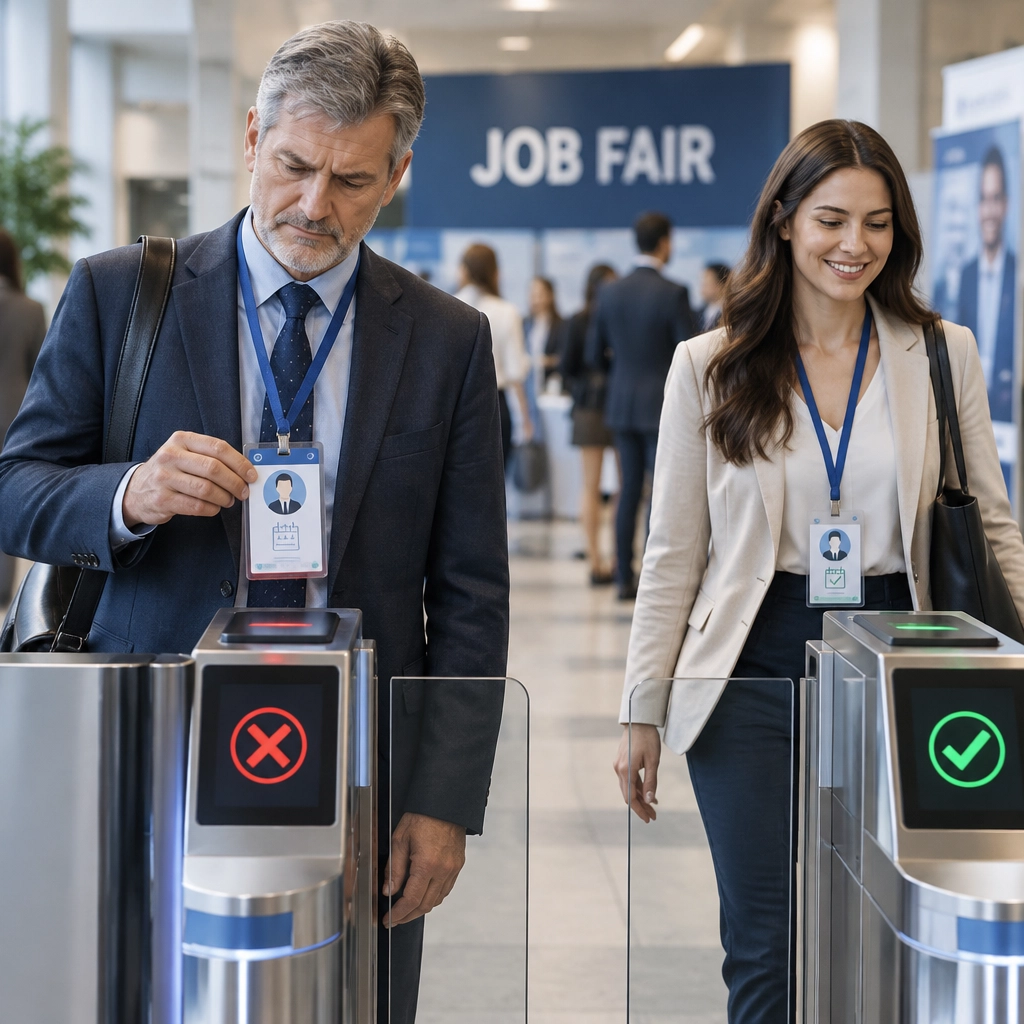
When “Energy” Becomes A Score
A polite smile is not a reliable measure of competence. Yet a video interview platform that scores expressions or communication style can turn subjective judgments into a number that looks scientific.
This is especially concerning when a candidate’s age, accent, disability, neurodivergence, or personal communication style affects how they appear on camera. A low score does not automatically mean discrimination occurred. It does mean employers should be able to explain what the score measures, how it is validated, and whether it predicts actual job performance.

The Pivot: Why Franchising Beats Corporate Employment
If corporate hiring feels like a system in which someone else controls the filter, business ownership offers a different role: you are responsible for building and running the operation, rather than waiting to be ranked for a job opening.
That does not mean a franchise is an escape hatch from uncertainty. Franchise ownership involves investment, operating demands, customer acquisition, staffing, and financial risk. A franchise system may use technology, and a business can struggle or fail. You exchange dependence on one employer for responsibility to customers, employees, suppliers, and a franchisor.
The distinction is control, not certainty. As an owner, you make decisions about how to apply your experience and build value. Technical workers may bring process discipline; manufacturers may understand quality and operations; truckers may know logistics, service, and customer needs. Those skills can transfer to many franchise models, including industries outside a buyer’s previous career.
The best franchises to own are not the same for everyone. Your fit depends on your capital, goals, location, time, and willingness to manage people and daily operations. A franchise for sale is not automatically the right purchase simply because a job search is frustrating. Start by comparing franchise opportunities that align with the life and financial commitments you can realistically support.
How To Investigate With Evidence (Before Any Pitch)
Before you decide how to buy a franchise, write down your constraints. What can you invest without putting essential savings at risk? How much working capital might you need? Do you want to operate the business yourself, manage a team, or hire an operator? Consider startup expenses, fees, equipment, rent, staffing, debt, and the time required to build demand.
Then review the Franchise Disclosure Document (FDD). Pay attention to fees, litigation and bankruptcy disclosures, required purchases, territory terms, training, support, and renewal, transfer, or termination conditions. The FTC’s Consumer Guide to Buying a Franchise and Franchise Rule Compliance Guide explain important parts of the process. Generally, you must receive the FDD at least 14 days before signing or paying the franchisor or an affiliate.
If the FDD includes financial performance information, check what is reported and what costs may be excluded. Revenue is not profit, and disclosed results do not predict your outcome. Speak with current and former franchisees listed in the FDD. Ask about their real costs, staffing, customer demand, and the support they received. Consider independent review by a franchise attorney and an accountant. The SBA Franchise Directory can help you check whether a brand is eligible for certain SBA financing programs; directory inclusion is not an endorsement, financing approval, or guarantee of success.
A franchise consultant can help you organize the search, compare options, and make introductions. Understand how the consultant is compensated and what that means. FranLift’s service is free to candidates because franchise companies pay its costs from their marketing budgets. That can make it easier to explore options, but it does not replace your own due diligence or independent professional advice. Learn how FranLift works.
Start A Conversation With FranLift
You cannot change your graduation year. You can choose what to investigate next. If you are weighing a career pivot, consider whether business ownership belongs among your options, not as a guaranteed solution, but as a path worth evaluating on its facts and fit.
You can also read yesterday’s article on the “forever layoff” and the dashboards influencing workplace decisions. Then talk with a franchise consultant about your goals, budget, and preferred way of working. FranLift can help you explore a curated shortlist and make introductions. Start a conversation with FranLift.

THERE IS NO GUARANTEED INCOME. Past results, where disclosed, do not guarantee future performance.
This article is for informational purposes only and is not financial, legal, or career advice.
© 2026 FranLift. Launch Beyond Boundaries.
