


Launch Beyond Boundaries.
At 7:00 a.m., the future of work can look less like a dramatic robot takeover and more like a calendar invite titled “organizational update.”
For workers in IT, software development, manufacturing, and trucking, the concern is no longer theoretical. AI systems, industrial robotics, computer vision, route optimization, and autonomous vehicle technology are changing which tasks companies need humans to perform, and how many humans they need to perform them.
That does not mean every job disappears tomorrow. It does mean your income may remain controlled by an employer whose business model can change faster than your career plan.
For many experienced professionals, the more useful question is not, “Will AI replace me?” It is:
What can I own that uses my experience, serves a real market, and does not depend on one employer preserving my job?
The Hard Truth About AI And Your Job
The most important distinction is between job exposure and actual job loss. Exposure means technology can perform or significantly alter tasks within a role. Displacement means an employer or customer actually reduces demand for that labor.
The evidence shows both are developing, particularly in specific functions.
IT And Software: Routine Code Is Becoming A Commodity
A 2026 analysis from Tufts University’s Digital Planet project ranks several technology occupations among the most vulnerable to AI-driven job loss over the next two to five years. Its modeled estimates identify:
- Computer programmers: approximately 55.2% potential job loss
- Web and digital interface designers: approximately 54.6%
- Web developers: approximately 46.2%
- Database architects: approximately 46.0%
- Software quality assurance analysts and testers: approximately 36.4%
These are projections, not guaranteed outcomes. They nevertheless identify where employers can reduce labor demand first.
The functions under pressure are specific:
- Boilerplate application code and simple scripts
- CRUD features and routine integrations
- Code translation between languages
- Basic unit-test generation
- Regression-test maintenance
- Technical documentation and API examples
- Simple internal tools built from natural-language prompts
- Entry-level bug triage and support tickets
A 2026 systematic review published in Frontiers in Human Dynamics found a 14% to 41% reduction in postings for entry- and mid-level software development roles across the studies it synthesized between 2022 and 2024. The same review found that security, infrastructure, and validation roles can expand even as routine development contracts.
That creates a particularly unpleasant career bottleneck: AI can reduce the junior work people traditionally used to become senior professionals.
The robot may not eliminate every developer. It may simply eliminate the job that was supposed to teach you how to become one.

Manufacturing: Robots Do Not Need A Performance Review
Manufacturing faces a different form of disruption. Generative AI affects planning, documentation, and administration, while robotics and computer vision affect physical production.
The Tufts model estimates approximately 4.3% of U.S. manufacturing jobs, about 534,000 positions, could be vulnerable to AI-related displacement under its median adoption scenario. That figure includes a broad range of work and should not be interpreted as a direct count of layoffs caused exclusively by AI.
The functions most exposed to automation include:
- Pick-and-place assembly
- Robotic welding and packaging
- Machine tending
- Visual quality inspection
- Defect detection
- Material movement inside facilities
- Inventory counting and tracking
- Production scheduling
- Basic procurement and planning coordination
A quality inspector may not be replaced by one humanoid robot walking into the plant with a clipboard. The more likely scenario is an AI vision system inspecting every product continuously while one human supervises several automated lines.
The job changes first. Headcount follows when management decides the new workflow is reliable and financially attractive.
Trucking And Logistics: The Cab Is Not The Only Target
Trucking is often discussed as though the only threat is a fully autonomous tractor-trailer. That is too narrow.
AI is already positioned to reduce labor demand in the support functions surrounding transportation:
- Dispatching
- Route planning
- Load matching
- Shipment tracking
- Customer status updates
- Bill-of-lading preparation
- Appointment scheduling
- Basic compliance documentation
- Fleet maintenance forecasting
Tufts projects approximately 2.3% of transportation and warehousing jobs, about 165,000 positions, could be vulnerable under its median scenario. Long-haul driving remains a longer-term issue because autonomous deployment depends on regulation, insurance, infrastructure, weather, and route economics. But dispatch and coordination work can be automated without waiting for every truck to drive itself.
The practical threat is therefore layered:
- Software reduces back-office labor.
- Routing systems reduce coordination time.
- Driver-assistance technology increases productivity.
- Autonomous highway operations may eventually reduce demand for long-haul drivers.
Gallup’s August 2026 Work and Education survey found that 27% of U.S. workers worry technology could soon make their jobs obsolete, up from 20% the prior year and roughly double the 2017 figure. Among workers under 45, technological displacement tied benefit reductions as the leading job concern.
The anxiety is rational. But anxiety is not a business strategy.
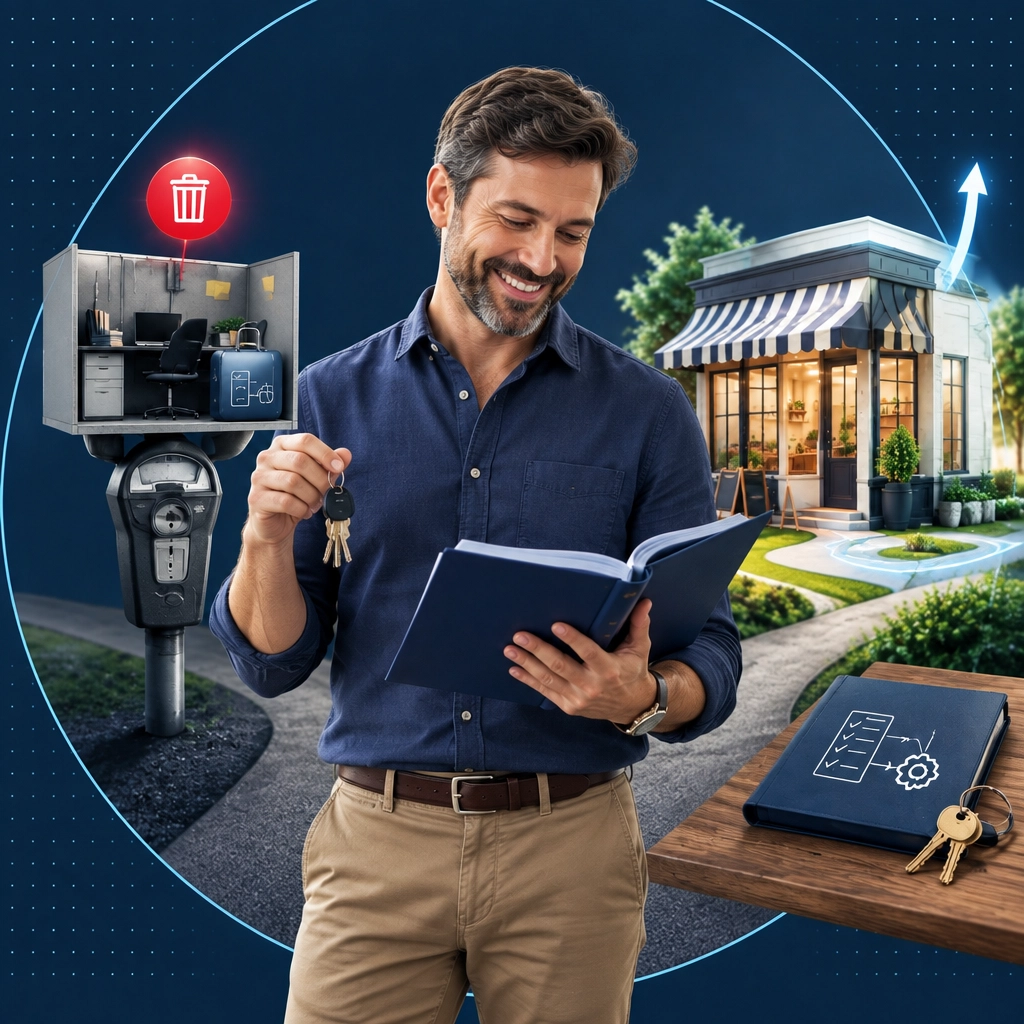
The Pivot: From Rentable Labor To Ownership
Corporate employment gives you a paycheck in exchange for labor, expertise, and availability. The employer owns the customer relationship, operating system, pricing model, brand, and capital structure.
You own the risk of being useful.
That arrangement can work well, until one employer automates your tasks, outsources your function, closes a facility, changes direction, or decides that a smaller team can produce the same output.
Franchise ownership changes the position. You are no longer selling your working hours to one organization. You are operating an established business model in a defined market.
That does not make income automatic. It gives you more control over the asset being built.
A franchise can provide:
- A tested operating playbook
- Brand standards and customer acquisition support
- Training and onboarding
- Vendor relationships
- Technology systems
- Territory guidelines
- Ongoing operational guidance
- A structure for hiring and delegation
For someone with a technical or logistics background, that structure can be an advantage rather than a limitation. You already understand systems, process discipline, troubleshooting, metrics, scheduling, and continuous improvement.
The best franchises to own are not identical for every buyer. The right opportunity depends on your capital, location, lifestyle, risk tolerance, desired owner role, and ability to manage people.
Franchise Categories That May Fit Technical And Logistics Experience
A technical professional may evaluate:
- Business-to-business technology services
- IT support and managed services
- Commercial maintenance systems
- Education and skills training
- Business consulting and operational services
A manufacturing professional may consider:
- Industrial or commercial services
- Equipment maintenance
- Safety and compliance services
- Supply-chain support
- Home and commercial improvement businesses
A trucking or logistics professional may evaluate:
- Local delivery and route-based services
- Commercial transportation support
- Staffing and workforce services
- Warehousing-related services
- Mobile businesses with scheduling and dispatch components
These categories are starting points, not recommendations. A franchise consultant should help determine whether the economics, territory, staffing model, and daily work actually fit you.
Semi-Absentee Does Not Mean Sleep-Through-The-Launch
Semi-absentee franchise opportunities can be attractive to professionals who want ownership without personally performing every customer transaction. They may also suit people with operational backgrounds who are comfortable building systems, hiring managers, and monitoring performance.
However, “semi-absentee” is not synonymous with passive income.
Most businesses require meaningful owner involvement during launch. You may need to recruit employees, learn the model, establish local relationships, monitor quality, and correct problems before delegation becomes practical.
Ask every franchisor:
- How many hours do owners work during the first year?
- What responsibilities remain with the owner after hiring a manager?
- How long does manager recruitment typically take?
- What happens if the manager leaves?
- What working capital is required before the business reaches break-even?
- Which financial performance claims are disclosed in Item 19 of the FDD?
- How many franchisees operate under the same staffing model?
A credible opportunity should survive detailed questions.
How To Buy A Franchise Without Repeating Corporate Risk
Searching for a franchise for sale is not the same as choosing a business. Start with your personal operating requirements.
Define:
- Available liquid capital
- Acceptable debt payment
- Personal financial runway
- Preferred work schedule
- Desired owner involvement
- Geographic limits
- Staffing tolerance
- Customer-facing comfort
- Short-term income requirements
- Long-term wealth-building goals
Then review the full investment, not just the franchise fee. Budget for equipment, leasehold improvements, insurance, licenses, technology, initial marketing, payroll, rent, royalties, and working capital.
Before signing, request and review the Franchise Disclosure Document. The Federal Trade Commission’s Franchise Rule generally requires prospective franchisees to receive the FDD at least 14 calendar days before signing a binding agreement or making a payment.
Use that time to:
- Review startup and ongoing costs
- Examine territory rights
- Study litigation and bankruptcy disclosures
- Read renewal and termination provisions
- Review Item 19 financial performance information, if provided
- Contact current and former franchisees listed in Item 20
- Test the business model against conservative revenue assumptions
- Have a franchise attorney and financial professional review the documents
The goal is not to find a business with no risk. That business does not exist. The goal is to understand the risk before you commit capital.
Talk With A Franchise Consultant Before You Choose
You do not need to review thousands of franchise opportunities alone.
FranLift helps prospective owners clarify their goals, research industries, narrow the market, compare suitable brands, arrange introductions, and connect with funding partners and franchise attorneys. The service is free to the buyer because participating franchise companies cover FranLift’s costs through their franchise development budgets.

A franchise consultant does not replace your attorney, accountant, lender, or independent judgment. You remain responsible for reviewing the FDD and deciding whether the opportunity fits your finances and life.
But the first conversation can give you a structured answer to the question, “How do I buy a franchise?”
Start with FranLift’s franchise matchmaking process or schedule an initial consultation.
AI may continue taking tasks, titles, and desks. Ownership gives you the opportunity to build something that is not dependent on a single employer’s next automation decision.
Educational purposes only. Franchise ownership involves financial risk and is not a guarantee of income or success. Review franchise documents with qualified legal, financial, tax, and other professional advisors before investing.
© 2026 FranLift. All rights reserved.
