


Your job may not disappear in a dramatic meeting with human resources. It may disappear one task at a time.
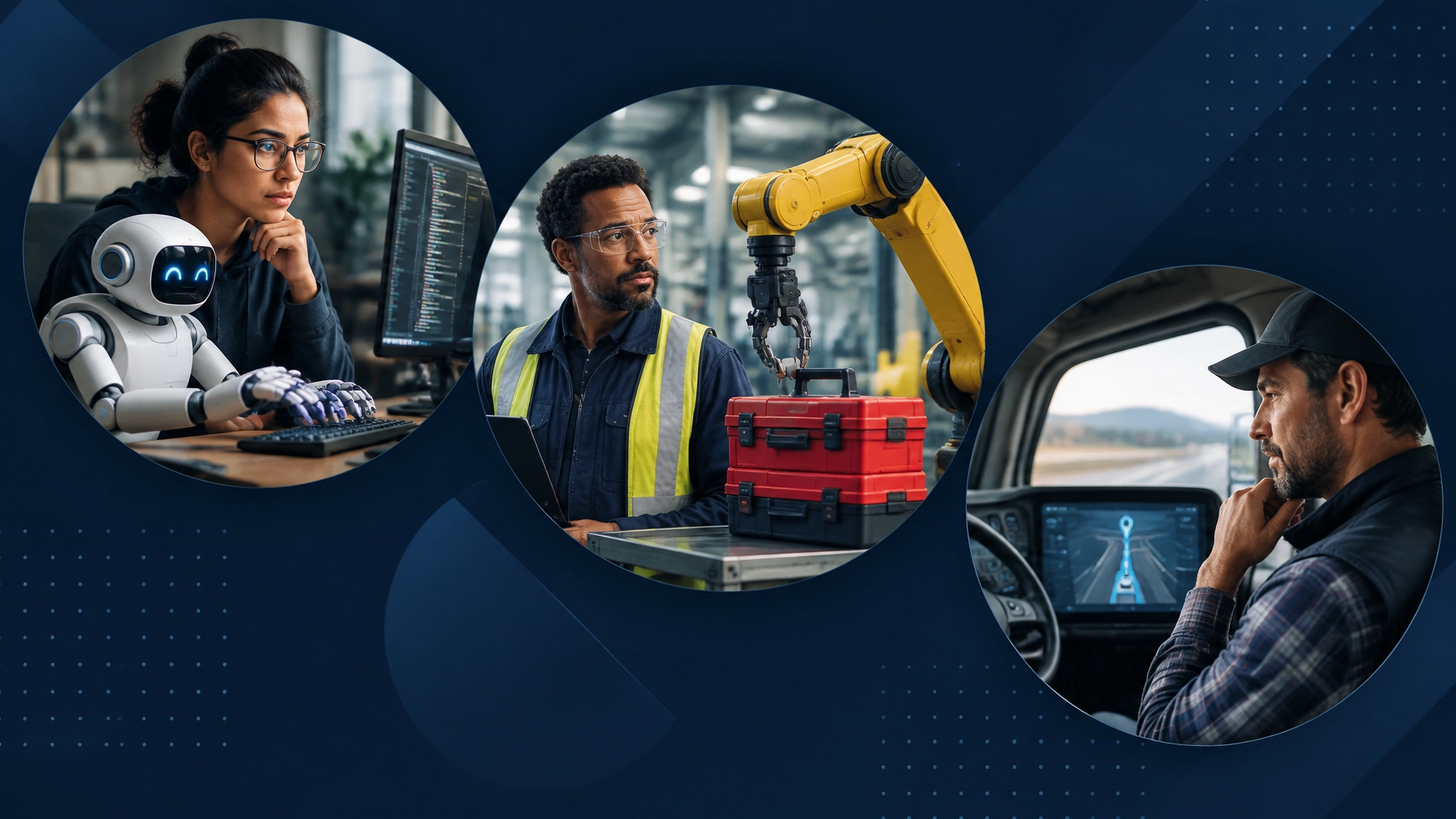
The code review becomes automated. The production line needs fewer operators. The long-haul route is optimized by software, sensors, and autonomous vehicle systems. Then your employer announces a “strategic workforce transformation,” and the work you once performed has been absorbed into a system that does not take vacations, request raises, or need a desk.
This is the central question of the AI and Automation Disruption era:
Will you continue renting out your hours, or will you use your experience to build an asset you control?
Buying a franchise for sale in the United States is not a guaranteed escape from economic change. It is a structured path toward ownership, local control, and diversified income, provided you evaluate the opportunity like an investor rather than reacting like a frightened job seeker.
The Hard Truth About AI, IT, Manufacturing, And Trucking
The employment outlook is more complicated than “AI will eliminate every job.” Some roles will grow. Others will be fundamentally redesigned. The danger is not only total job loss. It is losing bargaining power as fewer people are needed to produce the same result.
The World Economic Forum’s Future of Jobs Report 2025 estimates that 22% of today’s jobs will be structurally transformed by 2030. Employers surveyed expect approximately 170 million jobs to be created and 92 million to be displaced globally. That is a net gain, but a net gain does not help the individual whose role is eliminated in a specific city, company, or industry.
In the United States, SHRM research on automation and generative AI found that 15.1% of jobs already have at least half of their tasks automated, while 7.8% use generative AI for at least half of their tasks. SHRM’s stricter analysis identified millions of jobs facing elevated near-term displacement risk after accounting for real-world barriers such as regulations, customer expectations, and organizational complexity.
For IT and coding professionals, the message is not that software development is already obsolete. The Bureau of Labor Statistics projects strong growth for software developers through 2034. But the work is changing quickly. Routine coding, testing, documentation, and support tasks are increasingly assisted or completed by AI. The value is moving toward architecture, integration, security, client relationships, and business ownership.
Manufacturing faces a different pressure. BLS states that advances in automation will continue to reduce demand for production occupations. A plant can increase output without increasing headcount. That means technical skill alone may not protect a worker if the employer’s strategic objective is to produce more with fewer people.
Trucking and logistics are also entering a transition period. The MIT Sloan and MIT Center for Transportation & Logistics analysis of AI and the transportation workforce identifies approximately $65 billion in highly AI-exposed transportation task wages and potential annual cost reductions of $1 billion to $4 billion if technologies such as autonomous trucking and clerical automation scale. The researchers also conclude that complete automation is unlikely in the near term.
That distinction matters. Your job does not need to vanish completely for your income, schedule, or bargaining position to deteriorate.
The Pivot From Employee To Owner
Corporate employment pays you for performing a role inside someone else’s system. Franchise ownership allows you to operate a system while building an enterprise with transferable value.
That does not mean a franchise is passive income. Most franchise owners work intensely during the launch and development stages. The difference is that the work can create customer relationships, operating cash flow, local goodwill, trained teams, and a sellable business.
Your existing skills can transfer directly:
- An IT professional may bring project management, systems thinking, troubleshooting, and process design.
- A manufacturing leader may bring quality control, scheduling, safety discipline, staffing, and operational efficiency.
- A truck driver or logistics manager may bring route planning, fleet coordination, customer service, and time-sensitive execution.
- A former corporate manager may bring budgeting, recruiting, sales, and performance management.
These skills can apply across service, home improvement, logistics, automotive, education, wellness, retail, and other franchise opportunities. You do not necessarily need prior industry experience. You need the ability to follow a proven system, manage people, serve customers, and make disciplined decisions.
The strongest franchise models also give you control over local execution. You determine how to hire, market, schedule, and serve customers in your territory. The franchisor provides brand standards, training, systems, and support. You build the local operation.
That is a different risk profile from depending on one employer’s technology roadmap.

How To Buy A Franchise Responsibly
“How to buy a franchise” is not answered by choosing the most recognizable brand or the opportunity with the most impressive sales presentation. It starts with matching the business model to your capital, risk tolerance, skills, goals, and preferred level of involvement.
Begin by deciding whether you want:
- An owner-operated business or a manager-led model
- A storefront, mobile, home-based, or territory-based operation
- Recurring revenue or transaction-based sales
- A business with employees or a lean service model
- A new unit or an existing franchise for sale
A new unit may provide a defined territory, current training, and a clean operating start. It may also require construction, permitting, customer acquisition, hiring, and a longer ramp to break-even.
An existing franchise for sale can provide operating history, equipment, employees, customers, and revenue data. It can also carry lease obligations, deferred maintenance, staffing problems, seller disputes, or performance issues. Investigate why the owner is selling and require the franchisor’s approval before treating the transaction as viable.
Read The FDD Like An Investor
The Federal Trade Commission requires franchisors to provide a Franchise Disclosure Document, or FDD, containing 23 disclosure items. Under the FTC Franchise Rule, you generally must receive the FDD at least 14 days before signing or paying the franchisor.
Pay particular attention to these items:
- Items 5–7: Initial fees, other fees, and estimated initial investment. Build a realistic budget that includes working capital, debt payments, taxes, insurance, payroll, and personal living expenses.
- Item 11: Training, advertising, technology, and ongoing support. Identify what the franchisor promises and what it merely describes.
- Item 12: Territory. Determine whether your territory is exclusive, protected, or simply assigned. Ask how online sales, national accounts, mobile units, and nearby franchisees affect your market.
- Item 17: Renewal, termination, transfer, dispute resolution, and other contractual obligations. This is where exit restrictions and renewal conditions often become clear.
- Item 19: Financial performance representations. If the franchisor makes earnings claims, they must appear here. If Item 19 is absent, that does not automatically disqualify the brand, but you should not rely on informal promises.
- Item 20: Current and former franchisees. Contact both groups. Ask about actual ramp-up time, franchisor support, staffing, margins, territory conflict, and whether they would invest again.
- Item 21: Audited financial statements. Review the franchisor’s financial condition with qualified professional help.
- Item 22: Proposed contracts and agreements. Compare the sales conversation with the documents you may actually sign.
Do not evaluate revenue without evaluating expenses. Unit economics should include labor, rent, royalties, technology fees, insurance, marketing contributions, vehicle costs, inventory, maintenance, and debt service. A business with impressive gross sales can still produce weak owner cash flow.

Use A Franchise Consultant Before You Commit
A franchise consultant can help you narrow thousands of brands into a practical shortlist based on your goals, available capital, preferred work style, and desired market. The consultant can also coordinate introductions to franchisors, funding partners, and franchise attorneys.
FranLift provides this service at no cost to buyers because participating franchisors cover the expense through their franchise development budgets. That makes an initial consultation a sensible first step, not a commitment to buy.

FranLift’s franchise matching process is designed to identify opportunities that fit your financial position and operating preferences rather than pushing you toward a single category. You can also contact FranLift for a free consultation.
Use legal and financial professionals before signing. A consultant can help you compare franchise opportunities, but a franchise attorney should review the agreement, and a qualified accountant should examine the financial assumptions.
The objective is not to outrun AI. The objective is to stop allowing one employer, one platform, or one technology decision to determine your entire economic future.
Sources And Further Reading
- World Economic Forum: Future of Jobs Report 2025
- SHRM: Automation, AI, And Job Displacement Risk In U.S. Employment
- Bureau of Labor Statistics: Artificial Intelligence, Information Technology, And Employment, 2024–34
- Bureau of Labor Statistics: Industry And Occupational Employment Projections
- MIT Sloan: AI And The Transportation Workforce
- Federal Trade Commission: A Consumer’s Guide To Buying A Franchise
Educational disclaimer: This article is for general educational purposes only and does not constitute legal, financial, tax, investment, employment, or franchise advice. Franchise investments involve risk, and results are not guaranteed. Review the applicable FDD and agreements with qualified legal and financial professionals before making a decision.
Launch Beyond Boundaries.
