

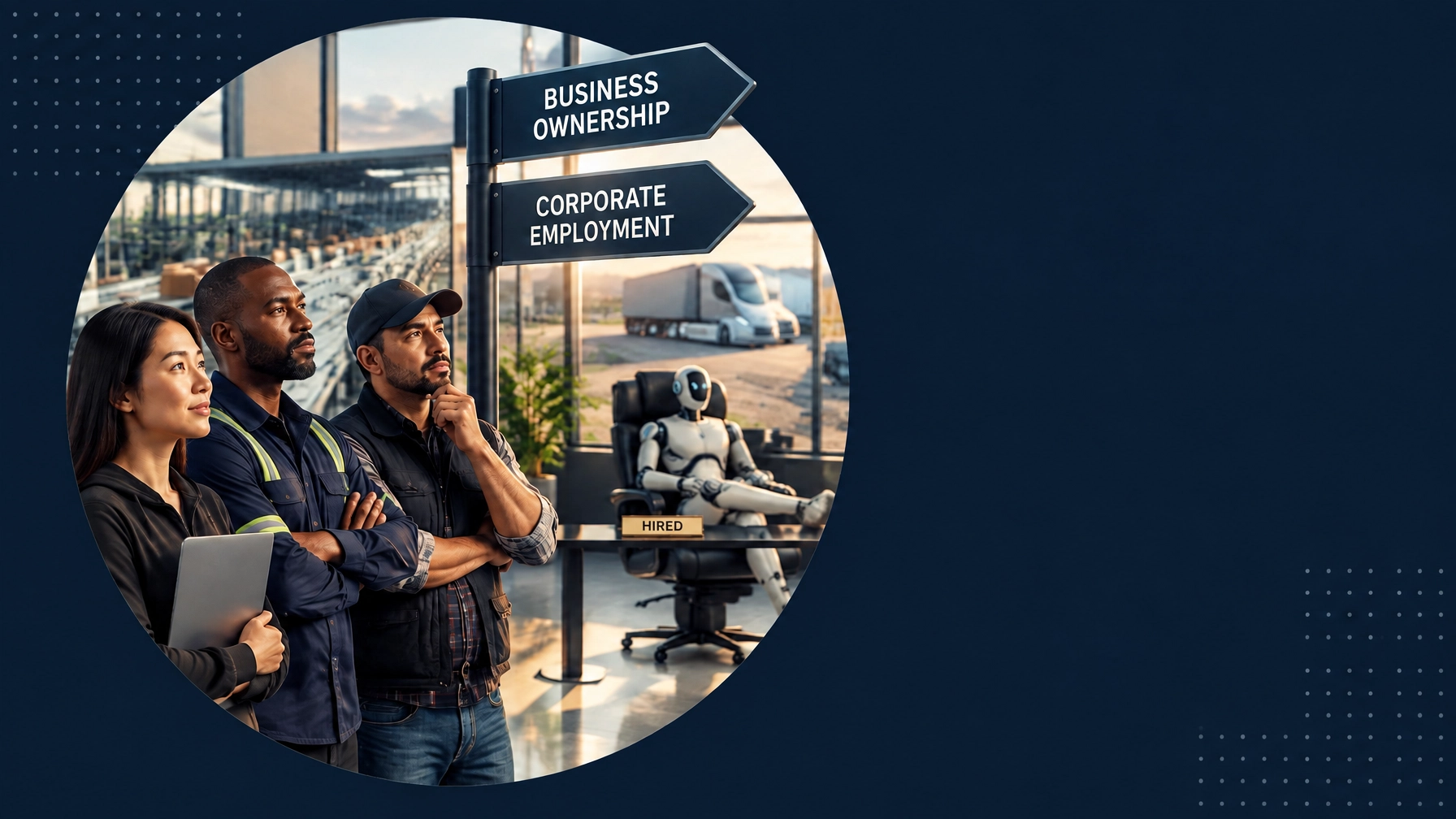
Launch Beyond Boundaries: build an owned future with a proven framework.
The safe job is becoming a historical concept.
For decades, the middle-class ladder worked like this: learn a trade, build experience, earn promotions, and trade your labor for rising income. That ladder is now being sawed apart in sections.
Coding assistants are absorbing routine development work. Robotic systems are taking over repetitive manufacturing tasks. Autonomous freight technology is advancing toward driver-light and driverless corridors. The disruption is not theoretical anymore, but it is also not evenly distributed.
If your job has been reduced, restructured, or placed on an automation roadmap, the next decision matters. You can compete for another seat inside a system that may keep shrinking, or you can investigate franchise opportunities that let you own an operating asset supported by a brand, playbook, training, and supply chain.
That does not make franchise ownership risk-free. It does give you a different relationship with work.
The Hard Truth: AI Is Removing The Middle Of The Career Ladder
The most useful way to interpret AI disruption is not “every job will disappear.” That claim is too broad. The real pattern is more precise and more uncomfortable:
Employers need fewer people to complete certain tasks, and entry-level workers are often first in line for the reduction.
The International Labour Organization’s 2025 update estimates that approximately one in four workers globally is in an occupation with some exposure to generative AI. It also estimates that only about 3.3% of global employment falls into its highest exposure category. Most jobs are more likely to be transformed than fully eliminated, but transformation can still mean fewer openings, slower wage growth, or a career path with the first rung missing.
The ILO research brief states the key distinction clearly: exposure does not equal full automation, but partial automation can reduce demand for an occupation if new responsibilities do not replace the old ones.
IT And Coding: Fewer Junior Seats At The Table
Software professionals are among the most exposed workers because coding assistants can generate, test, document, and revise routine code at high speed.
A 2026 review in Frontiers in Human Dynamics found that studies observed a 14% to 41% reduction in postings for entry- and mid-level software development and content roles in high-income economies between 2022 and 2024. The median decline across the studies was 23%.
That is not the same as saying 23% of developers were fired. Job postings measure employer demand, not a direct layoff count. But the signal is serious: companies can use AI to consolidate work that previously trained junior developers, testers, technical writers, and support staff.
A separate Stanford working paper, summarized by Econofact, found that early-career workers ages 22 to 25 in the most AI-exposed occupations experienced a 13% employment decline relative to less-exposed occupations.
The dark joke is that AI may not take your job. It may simply take the job you needed to qualify for the next one.
Manufacturing: The Robot Does Not Need A Lunch Break
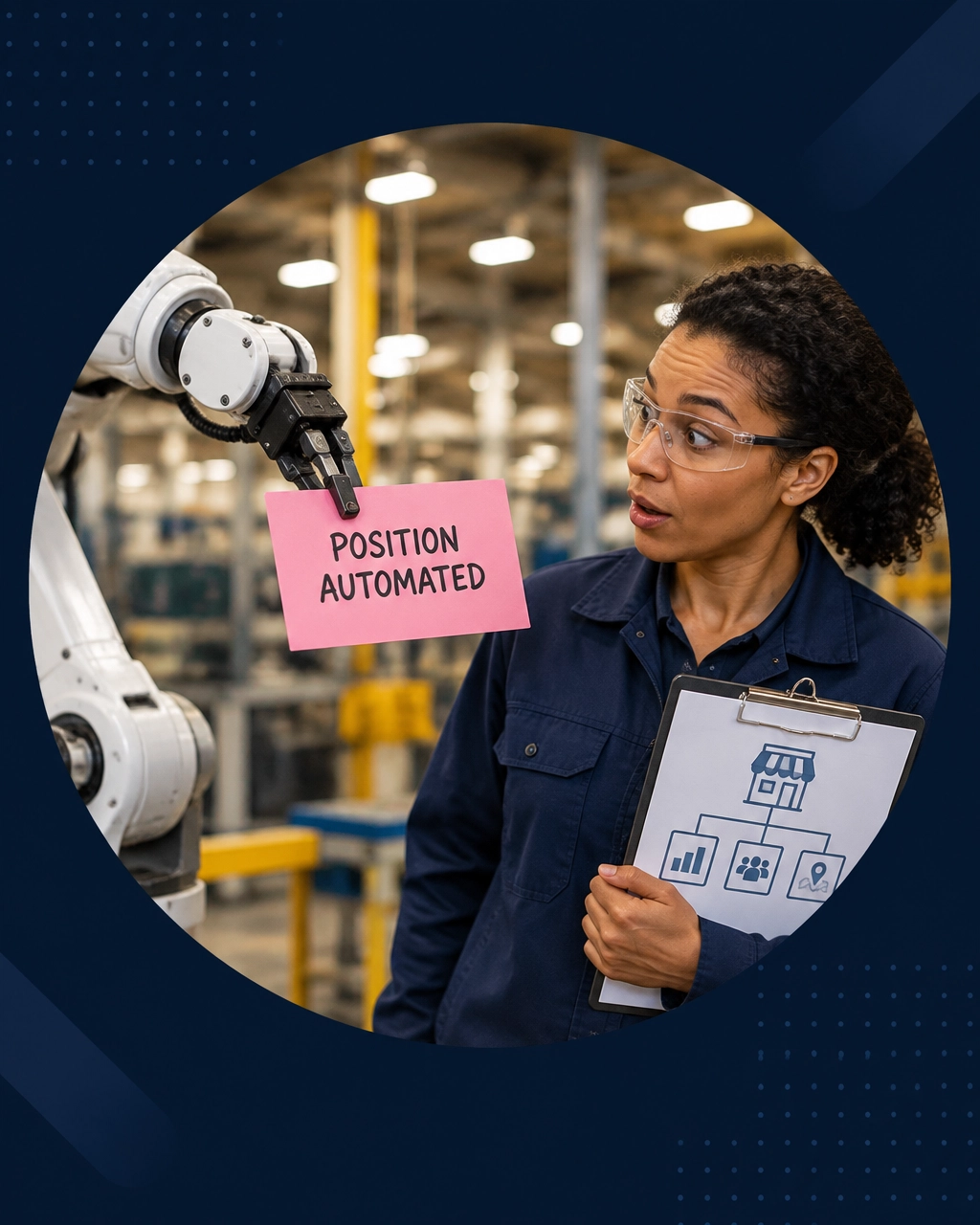
Manufacturing automation is not limited to one machine replacing one worker. The larger shift involves integrated systems: machine vision, robotic assembly, predictive maintenance, automated quality inspection, and software that coordinates production with fewer manual interventions.
The evidence requires honesty. There is no single credible national statistic that isolates exactly how many U.S. manufacturing jobs in 2026 were eliminated specifically by AI-powered robotics rather than by trade, plant closures, productivity changes, or ordinary business cycles.
There is, however, a clear pressure point. Routine, repetitive, measurable tasks are easier to automate than work requiring judgment, safety coordination, complex repairs, customer relationships, or leadership. The Society for Human Resource Management’s automation research estimates that 12.6% of current U.S. employment faces high or very high automation displacement risk.
For factory workers, the question is not whether robots can perform one task. It is whether one supervisor, supported by connected equipment and software, can oversee a production process that previously required several people.
That is how a job can disappear without a dramatic scene. No robot has to hand you a pink slip. The labor budget simply becomes smaller.
Trucking: The Driver May Still Be Needed, But The Route Is Changing
Autonomous freight corridors, platooning systems, remote assistance, and advanced driver-assistance technology are putting pressure on long-haul trucking’s traditional model.
The responsible conclusion today is not that autonomous trucks have already displaced truck drivers nationwide. Major labor datasets do not yet provide a clean, nationally aggregated count of truck-driver job losses caused by autonomous freight corridors.
The pressure is still real. If autonomous systems eventually handle more highway miles, carriers may reorganize drivers into local delivery, yard operations, exception handling, remote support, or customer-facing roles. A driver may not lose every opportunity, but the most valuable part of the traditional role, the long highway segment, could become less labor-intensive.
A career built around a truck-sized loan deserves more than a vague promise that “technology will create new jobs.” It deserves a plan that accounts for equipment debt, licensing, income volatility, and the possibility that the asset generating your income may depreciate faster than expected.

The Pivot: Own The Asset Instead Of Renting Your Labor
Corporate employment pays you for access to your time, judgment, and output. A franchise gives you the opportunity to own a business system that can produce value beyond your individual hours.
That distinction matters when your occupation is being automated.
As an owner, you are still responsible for performance. You still manage people, customers, vendors, cash flow, and compliance. But you are building an operating asset rather than waiting for an employer to decide whether your role remains necessary.
A franchise can provide:
- A recognized brand and customer proposition
- Initial training and operating procedures
- Marketing systems and technology guidance
- Supplier and purchasing relationships
- Territory or market development support
- A peer network of franchise owners
- A framework for hiring and delegation
You do not have to invent a business from a blank page. That is the central advantage.
The tradeoff is that you accept franchise fees, royalties, advertising contributions, brand standards, approved suppliers, and contractual restrictions. Ownership is not unlimited freedom. It is control within a defined system.
Match Your Existing Skills To The Right Category
Your previous career can be useful even if the new business is unrelated.
Former IT and coding professionals may fit business-to-business services, cybersecurity, managed technology, digital marketing, commercial support, education, or technical consulting models. The strongest fit may be a business where customers value trust, implementation, accountability, and human problem-solving, not simply the production of code.
Manufacturing professionals may bring valuable experience in scheduling, quality control, safety, lean processes, maintenance, procurement, and team leadership. Those skills can transfer to commercial services, industrial support, home improvement, equipment maintenance, logistics, or essential repair businesses.
Trucking professionals understand routing, dispatch, fleet economics, maintenance schedules, compliance, customer deadlines, and operational discipline. Those skills may translate into logistics support, fleet services, moving, delivery management, commercial maintenance, or other mobile service businesses.
Categories described as recession-resistant (such as essential home services, repair, maintenance, senior care, and recurring business-to-business services) may offer more durable demand than discretionary concepts. “Recession-resistant” does not mean recession-proof. You still need to validate local demand, staffing, margins, and competition.
How To Buy A Franchise Without Making A Panic Decision
If you have savings, severance, a 401(k), home equity, or borrowing capacity, begin with a financial inventory.
Separate:
- Capital available for the business
- Personal emergency reserves
- Startup and buildout costs
- Working capital
- Debt-service obligations
- Household expenses during the ramp-up period
Do not invest every available dollar. A business that requires you to withdraw retirement funds and immediately earn a full salary creates unnecessary pressure.
Potential funding sources can include cash, conventional loans, SBA-backed loans, equipment financing, franchisor programs, business partners, seller financing for an existing unit, or retirement structures such as ROBS. A funding partner can explain eligibility and risk, but financing approval is not proof that the franchise is a good fit.
The next step in understanding how to buy a franchise is reviewing the Franchise Disclosure Document, or FDD. Have a franchise attorney review the agreement and an accountant test the assumptions.
Ask the franchisor:
- What does the owner do during a normal week?
- How much working capital do new owners actually need?
- What percentage of franchisees have closed, transferred, or left the system?
- How are territories protected?
- What are the total royalties and advertising obligations?
- What happens if hiring is difficult?
- Which services must be purchased from approved suppliers?
- What support is provided after initial training?
- Can you speak with current and former franchisees?
- What is the realistic path to break-even?
The goal is not to find a franchise that sounds exciting. It is to find a model that fits your capital, skills, schedule, market, and tolerance for operational responsibility.

Talk With A FranLift Franchise Consultant
There are thousands of franchise opportunities in the United States. Searching every franchise for sale independently can create the illusion of choice while making comparison more difficult.
FranLift helps prospective owners define their goals, review categories, narrow the field, compare brands, and coordinate introductions to franchisors, funding partners, and franchise attorneys. The service is free to the buyer because participating franchisors cover the cost through their franchise development budgets.
You should still ask how a franchise consultant is compensated and which brands they represent. FranLift’s matchmaking process is designed to connect your budget, experience, preferred lifestyle, and ownership goals with suitable franchise systems.
If AI has already changed your career path, do not wait for the next corporate restructuring to make the decision for you. Review your finances, identify transferable skills, and investigate whether ownership fits your next move.
Contact FranLift for a free consultation about your goals and available capital.
The future is not guaranteed. It can be built with better information, disciplined due diligence, and an operating system you own.
© 2026 FranLift. Launch Beyond Boundaries.
