


The most dangerous career signal is not always a layoff notice. Sometimes it is a hiring freeze, a smaller team, a new automation budget, or a job description quietly rewritten around software.
Artificial intelligence is changing the value of traditional work faster than many employees can respond. If your income depends on one employer continuing to value the same tasks you perform today, your career plan may already be controlled by someone else’s technology roadmap.
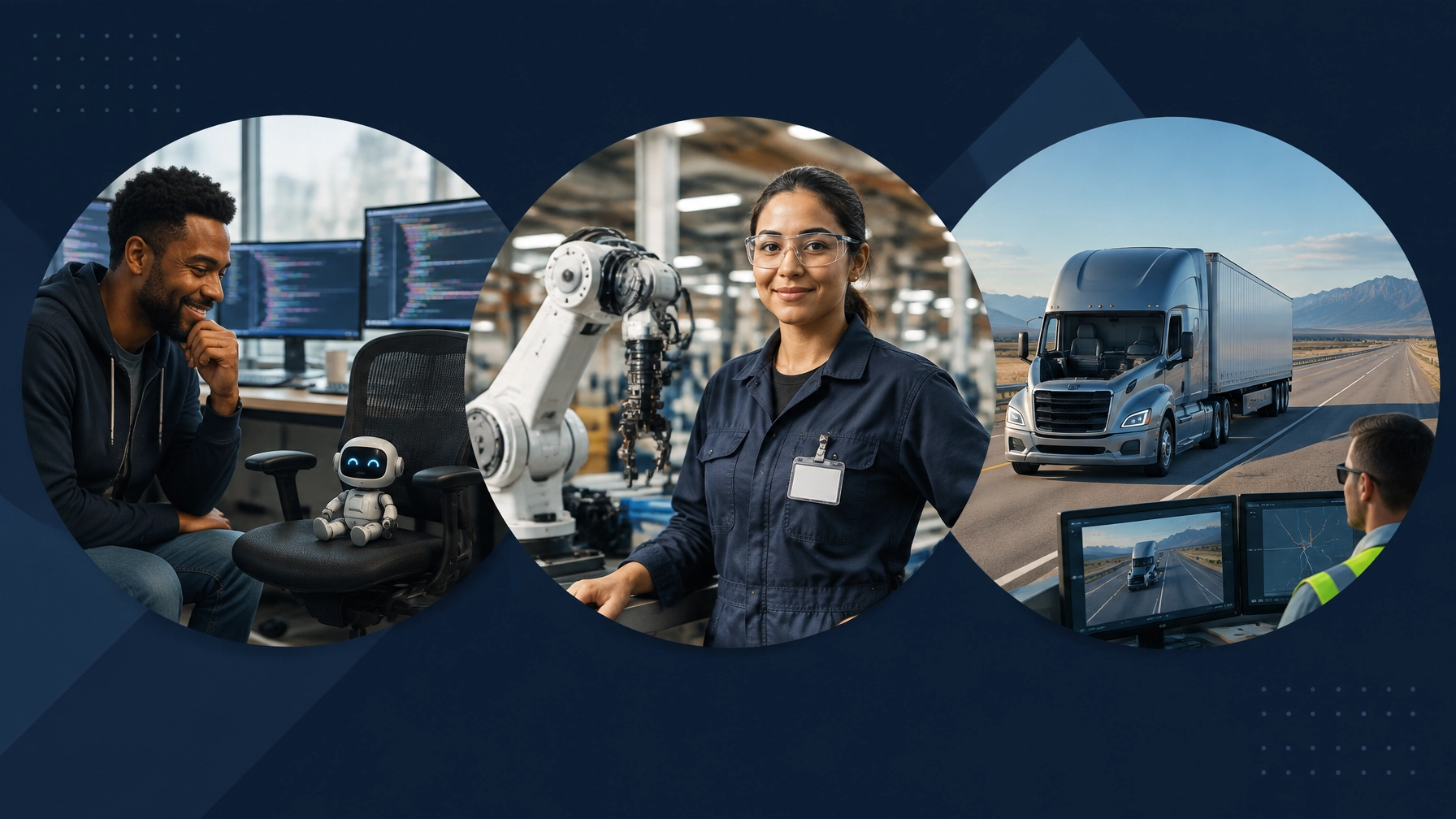
For IT professionals, manufacturing workers, and truck drivers, the question is no longer whether automation will affect work. It is how much control you will have when it does.
The Hard Truth
AI is not eliminating every job overnight. The more immediate threat is narrower and more disruptive: fewer entry-level opportunities, slower wage growth, reduced hiring, and greater pressure to reskill while still earning a living.
A 2025 compilation of employer announcements counted 54,836 U.S. job cuts explicitly connected to AI or automation. That figure does not represent every job affected by technology. It excludes roles that disappear through attrition, unfilled vacancies, reorganizations, and hiring decisions that never become public layoffs. The quieter forms of displacement can be harder to measure, and harder for workers to fight.
The evidence is especially clear in information technology and coding.
IT And Coding: The Entry-Level Ladder Is Narrowing
Anthropic’s March 2026 labor-market research found that computer programmers had approximately 75% task coverage in observed professional AI usage, and Stanford’s Digital Economy Lab has found that young workers in highly AI-exposed occupations are falling behind primarily through reduced hiring, not headline layoffs. That is the quiet hiring freeze version of disruption: the profession still exists, but the bottom rung gets thinner.
What changed over the last two years is not just that AI can assist developers. It is that coding agents are increasingly being used to complete multi-step tickets that once trained junior people. The old apprenticeship model gave entry-level workers bug fixes, test coverage, internal tools, documentation cleanup, and low-risk feature work. Those were not glamorous assignments, but they were how a career started. When software can now draft the code, explain the bug, update the tests, and package the pull request for review, companies need fewer beginners to do the work that used to justify hiring them.
That shifts the labor market in a damaging way even when total tech spending remains healthy. Senior engineers may still be needed for architecture, systems judgment, security, and customer-specific tradeoffs, but the junior rung can collapse long before the top of the ladder does. Readers should ask a hard question here: if the entry point disappears, what remains of a career ladder with no bottom rung?
The pressure is practical, not theoretical. A worker can spend months learning to code, pay for a bootcamp or certificate, and still enter a market where employers want one experienced engineer supervising AI tools instead of three developing humans learning on the job. In that environment, the threat is not just unemployment. It is a profession that still looks open from the outside while quietly reducing the number of people allowed to enter it.
Manufacturing: Robots Do Not Need A Severance Package
Manufacturing workers face a different version of the same risk. The factory floor may not be run entirely by machines, but automation investment is accelerating.
The International Federation of Robotics reported that U.S. industrial robot installations rose 11% year over year to 38,000 units in 2025. That matters because the current U.S. manufacturing story is not simply offshoring versus domestic production anymore. It is increasingly reshoring plus automation capex, which means plants can come back to the United States with fewer, more technical humans required per line.
This is why manufacturing disruption often feels confusing from the worker’s perspective. The building stays open. The company may even announce domestic expansion. The badge still works at the front door. But the job description changes underneath the employee. The machine operator becomes a cell monitor. The inspector becomes a data-checking function. The maintenance technician is now expected to troubleshoot sensors, controls, and software as much as belts and bearings. You keep your badge, but not your old job description.
That pattern can preserve employment counts for a while while still reducing bargaining power. One line can produce more with fewer people touching the product directly. Hiring shifts toward technicians, controls specialists, and reliability roles, while traditional production pathways shrink. Workers who cannot make that jump may not be terminated in a dramatic wave. They may simply find that overtime dries up, advancement slows, and the next opening goes to someone with automation fluency instead of shop-floor seniority.
Current manufacturing data do not show a universal automation-led layoff wave. Many manufacturers are automating because they cannot find enough skilled labor, because they want throughput, and because investors reward output per worker. That should not create false comfort. Reshoring headlines sound pro-worker until you notice how much of the new plant budget is going to equipment, software, and process engineering rather than to large crews.
Reskilling pressure is already here. The worker who waits for a formal announcement may be responding after the company has already decided which capabilities it needs next.
Trucking: The Road Is Open Today, But The Model Is Changing
Truck driving remains a large occupation with current demand. The Bureau of Labor Statistics projects employment for heavy and tractor-trailer truck drivers to grow through 2034, and the occupation’s median annual pay was approximately $57,440 in May 2024.
That makes trucking different from entry-level coding. Autonomous technology has not yet produced nationwide mass layoffs of drivers. But current employment does not eliminate long-term exposure.
A University of California, Berkeley analysis estimated that autonomous trucks could eventually put approximately 294,000 long-distance driving jobs at risk under a likely adoption scenario. The underlying economics matter. Highway miles are the cleanest part of the route for automation: long stretches, repeatable conditions, and expensive human driving hours that carriers would love to reduce first. Terminal work, customer interaction, loading problems, urban streets, weather judgment, and last-mile complexity are harder pieces to automate, so the likely transition is not “no humans at all.” It is fewer humans doing the profitable highway portion and more humans handling the messier edges.
That is where the wage risk becomes real. If a driver currently builds a middle-class life around long-haul miles, what happens to a $57,000 career when the highway portion is automated and the remaining human work shifts toward yard management, remote monitoring, transfer hubs, or local delivery that pays less? A worker can remain employed on paper while losing the earnings, schedule, or autonomy that made the occupation worth entering in the first place.
In other words, trucking may not disappear. The pay stack can. Income may shift away from driving hours and toward monitoring roles, terminal roles, and local route work with different economics. That is the same pattern seen elsewhere: the title survives, but the value inside the title changes.
That is the common thread across all three industries: automation does not have to erase every job to weaken your position. It only has to make your income dependent on fewer decisions made by people who do not report to you.
The Pivot
The alternative is not to panic and enroll in the next training program advertised as “future-proof.”
Retraining can be valuable. It can also place you back into another employment market where the most standardized tasks are being automated, the credential has become common, and your income still depends on an employer’s organizational chart.
The harder issue is reskilling math. If a credential costs several thousand dollars, requires six to eighteen months, and delays income while you study, the right question is not whether the program sounds modern. The right question is whether the destination role will still command durable human value by the time you arrive. A worker who spends $8,000 to $20,000 and half a year or more retraining into an entry-level technical role may be buying access to a labor market that has already cut its junior intake. A manufacturing worker who pays for a short industrial credential but still lacks the deeper controls, software, or troubleshooting experience employers now want may improve a resume without materially improving bargaining power. Brutal arithmetic beats inspirational marketing. If the path takes months, costs real money, and ends in another role exposed to automation pressure, the return on that reskilling bet may be weaker than advertised.
Franchise ownership changes the structure of the problem.
You are not purchasing immunity from economic change. You are building an operating business around a defined brand, a customer base, a territory, and a system that you can influence. Revenue still depends on execution, demand, staffing, and local market conditions, but it does not depend on one employer deciding that your role is no longer strategic.
That difference is substantial.
A franchise gives you access to systems that have already been developed, tested, documented, and refined by the franchisor. Training, operating procedures, marketing frameworks, technology platforms, vendor relationships, and brand standards are typically part of the model. You are still responsible for due diligence and performance, but you are not required to invent every process from a blank page.
You also do not necessarily need prior industry experience. FranLift notes that many franchisees enter industries where they have no previous professional background. The relevant question is whether the opportunity matches your capital, schedule, management strengths, risk tolerance, and desired level of owner involvement.
That is why the search for the best franchises to own should begin with fit, not hype.
When learning how to buy a franchise, start by defining the life and financial requirements the business must meet. Establish your available investment, liquidity reserve, target geography, preferred operating role, income timeline, and tolerance for employees, inventory, facilities, or customer-facing work. Then review the franchisor’s disclosure documents with qualified legal and financial professionals.
Compare the franchise against retraining honestly. Ask how long the new credential will take to produce income, how many employers are hiring for the resulting role, whether AI is improving or replacing that work, and what you will own after the training is complete.
With a franchise, you may build customer relationships, operating cash flow, local reputation, and an enterprise that can potentially be transferred or expanded. With retraining, you may gain a new qualification, but you may still be selling your time to one organization at a time.

A franchise is not automatically safer. Some require substantial capital, long hours, hiring, leases, and strict compliance. The franchise agreement may limit flexibility, and royalties or marketing fees affect the economics. You must review the Franchise Disclosure Document, validate financial assumptions, speak with current franchisees, and have a franchise attorney analyze the agreement.
The advantage is not certainty. The advantage is control, structure, and the opportunity to build an asset that is not entirely dependent on your next performance review.
Talk With A FranLift Franchise Consultant
You do not need to search thousands of franchise opportunities alone or choose a business simply because it is familiar.
FranLift begins with an initial consultation to understand your goals, budget, experience, location, lifestyle, and preferred level of involvement. The team then conducts market research, narrows the field to a curated shortlist, facilitates introductions to qualified franchisors, and can connect you with funding partners and franchise attorneys.
The service is free to candidates because participating franchise companies cover the cost through their franchise development budgets. That does not remove the need for independent due diligence, but it gives you a practical starting point before you commit capital or time.
A franchise consultant can help you compare service, education, wellness, home improvement, retail, automotive, hospitality, food, and other business models against the realities of your life, not against a generic ranking on the internet.
Review FranLift’s franchise matchmaking process and contact the team for a free consultation.

AI may change the work you perform. It does not have to decide who owns the next opportunity.
Launch Beyond Boundaries.
Copyright © 2026 FranLift. All rights reserved.
This article is for educational purposes only and is not legal, financial, or investment advice.
Sources And Further Reading
Anthropic, “Labor market impacts of AI: A new measure and early evidence.” https://www.anthropic.com/research/labor-market-impacts
Stanford Digital Economy Lab, “No Widespread Displacement, but the AI Employment Gap for Young Workers Is Growing.” https://digitaleconomy.stanford.edu/news/canariesaug26/
International Federation of Robotics, “US Robot Industry Returns to Double Digit Growth.” https://ifr.org/news/us-robot-industry-returns-to-double-digit-growth/1
U.S. Bureau of Labor Statistics, “Heavy and Tractor-Trailer Truck Drivers.” https://www.bls.gov/ooh/transportation-and-material-moving/heavy-and-tractor-trailer-truck-drivers.htm
UC Berkeley Labor Center, “Driverless? Autonomous Trucks and the Future of the American Trucker.” https://laborcenter.berkeley.edu/driverless/
Federal Trade Commission, “A Consumer’s Guide to Buying a Franchise.” https://www.ftc.gov/business-guidance/resources/consumers-guide-buying-franchise
Federal Trade Commission, “Franchise Rule Compliance Guide.” https://www.ftc.gov/business-guidance/resources/franchise-rule-compliance-guide
U.S. Small Business Administration, “7(a) loans.” https://www.sba.gov/funding-programs/loans/7a-loans
