


The headline numbers are startling. The decision they point to is personal: how much of your financial future depends on one employer’s org chart?
The Numbers Nobody Saw Coming (The Hard Truth)
A new analysis from Pew Research Center found a striking pattern in employment growth: as occupations become more exposed to generative AI, men’s employment has grown faster than women’s. The finding does not prove that AI caused the gap. But it challenges the idea that the AI job boom is benefiting workers evenly.
Pew scored 480 occupations on a scale from 0 to 3.5, using task data from the U.S. Department of Labor’s O*NET database to estimate how much generative AI can perform or assist with important tasks. Researchers then compared Current Population Survey employment data from 2017–2019 with data from January 2023 through June 2026, excluding the pandemic years.
For each one-point increase on the AI-exposure scale, men’s employment grew by 6.3%, compared with 0.2% for women. At an exposure score of zero, employment growth was -4.9% for men and -0.1% for women. At 3.5, it was 17.8% for men and 0.5% for women.
These are estimates of employment growth along the exposure scale, not a guarantee that any individual worker in a particular occupation will gain or lose a job. Still, the pattern deserves attention. Read Pew’s full analysis and methodology.
The Gender Divide Gets Sharper Below a Bachelor’s Degree
The education split is even harder to ignore. Among workers with a high school diploma or less, each one-point rise in occupational AI exposure was associated with men’s employment growing 8.8% and women’s employment declining 9.5%. For workers with some college, the estimates were +3.6% for men and -6.0% for women. Among workers with a bachelor’s degree or higher, neither group saw a statistically significant employment change associated with rising exposure.
That matters because people in similar broad education categories may be concentrated in very different occupations. Pew notes that women without a four-year degree are more likely to work in roles such as secretarial, reception and customer service positions. Work that often involves handling information and can sit nearer the middle or upper part of the exposure scale. Men without a college degree are more likely to work in occupations such as truck driving, construction labor and freight moving.
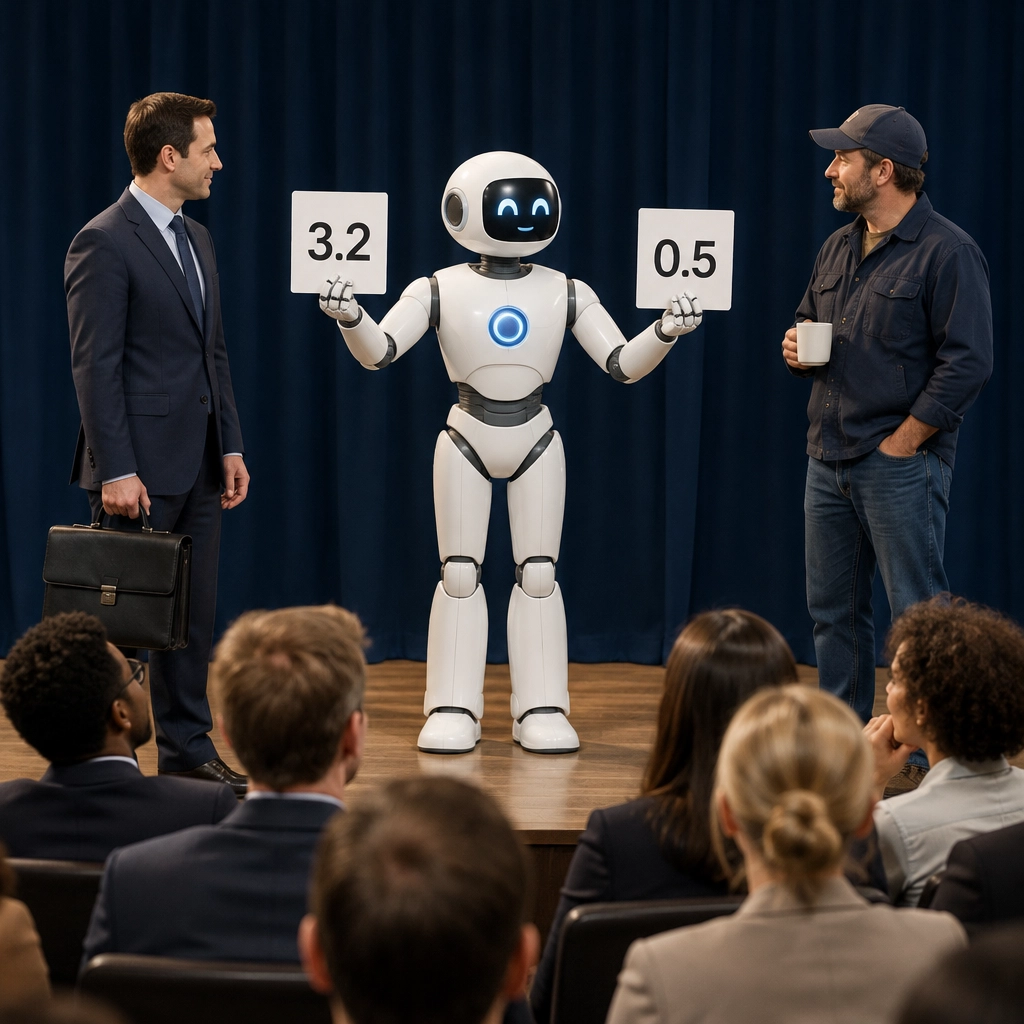
The exposure scores help illustrate the contrast: financial managers score 3.20, proofreaders and copy markers 2.36, medical assistants 1.54, carpenters 0.80, and driver/sales workers and truck drivers 0.49. Software developers also score highly, at 3.10, a reminder that technical work is not outside the conversation.
A low generative-AI score is not a promise of job security. The score measures overlap with generative-AI tasks, not the full impact of technology on an occupation. For manufacturing and trucking workers, robotics and other forms of automation are separate questions. And workers in highly exposed office, finance, clerical and IT roles should not assume that exposure alone determines what happens to their jobs.
The Honest Caveats Before You Panic
Pew is explicit: its results show an association, not proof of causation. The exposure scores estimate what generative AI can do or assist with, not what a particular employer has adopted or how it uses the tools. Employment is counted at the occupation level, so the composition of who enters, leaves or moves between occupations can affect the figures.
A Skills Intelligence analysis argues that the gender gap needs this composition check: the pattern may partly reflect which workers flow into growing occupations, rather than proving discrimination against women within an occupation. The bachelor’s-degree result also changes the picture substantially; the reported relationship was not statistically significant for either gender in that group. And January 2023 to June 2026 is a short window for judging a fast-changing labor market.
A separate warning comes from the AI “boomerang.” InformationWeek’s report describes companies reopening roles after AI-related cuts; some coverage puts the share near 29%, with returning or redesigned roles reportedly paying 20%–35% more. Sources in the report say rebuilding a cut role can cost 1.5 to 2 times the salary saved, while institutional knowledge does not automatically return with a new hire. These figures are not a forecast for every firm. They underline a practical point: even when the market swings back, it may not swing back on your old terms.
Ownership Changes Which Risks You Can Control
You cannot choose your occupation’s score on an exposure index. You can consider whether your income depends entirely on one employer’s hiring decisions, restructuring plans and technology investments.
Franchise ownership is one route to shifting that equation: instead of being measured only as a role on someone else’s org chart, you operate a business that may use technology to serve customers, improve workflows and manage operations. That does not make a franchise AI-proof. A franchise still depends on demand, costs, execution, the franchisor’s systems and local competition. It requires capital and sustained effort, and there is no guaranteed income.
The right question is not, “Which franchise will AI never touch?” It is, “What kind of business fits my skills, resources, risk tolerance and preferred day-to-day work, and how might technology affect its operations?” The answer could involve service, wellness, education, home improvement, food, retail or another sector. The best franchises to own are not the ones with the loudest pitch; they are the ones whose documented costs, operating demands and business model make sense for your circumstances.
If you are weighing a franchise for sale, take time to understand the full investment and the ongoing obligations before treating it as an alternative to employment. For a broader look at technology and skilled work, see our related article on manufacturing jobs and the AI skills premium.

How To Investigate With Evidence (Before Any Pitch)
Start with your own financial picture: available capital, financing needs, time commitment, income requirements and the work you want to do. Then compare franchise opportunities against those realities, not against promises about “recession-proof,” “AI-proof” or guaranteed returns.
If you want to understand how to buy a franchise, start with the Franchise Disclosure Document (FDD). The Federal Trade Commission’s consumer guide to buying a franchise explains what to examine. Its Franchise Rule Compliance Guide describes the disclosure requirements, including the 23 FDD items and the requirement to receive the document at least 14 calendar days before signing a binding agreement or making a payment to the franchisor or its affiliate.
Give particular attention to the estimated initial investment, other fees, required purchases, contract terms, financial statements and outlet history. Financial performance representations, if provided, should appear in Item 19; do not rely on earnings claims that are not properly disclosed. Speak with current and former franchisees listed in the FDD, and have an independent franchise attorney and qualified financial or tax professionals review the documents.
If SBA financing may be part of your plan, check the SBA Franchise Directory. Directory inclusion concerns eligibility for SBA financial assistance; it is not an SBA endorsement or a guarantee of profitability.
Start A Conversation With FranLift
A franchise consultant can help narrow a crowded market to options that fit your goals and budget, but the decision remains yours. FranLift’s matchmaking service is free to prospective buyers because franchise companies cover our costs as part of their marketing budgets. We begin with a conversation about your goals, experience, finances and preferred lifestyle, then use market research to curate potential matches. We can also make introductions to franchise companies, franchise attorneys and funding partners.

You can learn more about how FranLift works or contact us to start a conversation. Exploring ownership does not commit you to buying. It gives you a way to examine an option with evidence, ask better questions and decide whether the business fits your life.
THERE IS NO GUARANTEED INCOME. Past results, where disclosed, do not guarantee future performance.
This article is for informational purposes only and does not constitute legal, financial, or tax advice.
© 2026 FranLift. Launch Beyond Boundaries.
