

A new job can close the gap in your résumé. It cannot guarantee your pay recovers, your experience stays in demand, or your next employer won’t reorganize again.
That is the unsettling part of an AI layoff: getting hired again may not mean you have escaped the risk. It may mean you have re-entered the same cycle. This time with a little more experience and no more control over the next decision.
For workers in IT, coding, manufacturing, trucking, and other changing fields, the question is no longer only, “Can I get another job?” It is also, “What am I building when I do?”
The Hard Truth: Rehired Is Not Recovered
Goldman Sachs research covered by Fortune, Axios, and Business Insider finds that workers displaced from AI-exposed jobs take about one month longer to find new employment than other displaced workers. They are also roughly 10 percentage points more likely to still be unemployed a year after losing their jobs.
The research points to another difficult pattern: workers who do find new jobs often move into roles with similar or higher AI exposure. That does not mean another layoff is scheduled. It does mean a new job may not put much distance between a worker and the forces that disrupted the last one.
The figures are averages, not predictions for any individual. Goldman analyzed more than 15,000 displaced workers from 2016 to 2025. Because the survey does not ask whether AI directly caused a layoff, researchers estimated likely AI displacement using factors such as occupational exposure and industry adoption. The results show an association, not proof that AI caused every job loss or that every affected worker will remain unemployed.
Goldman describes this as part of a longer pattern: the scarring effects of technological change documented across roughly 40 years, including offshoring, automation, and the internet. AI is the newest chapter, not the first. Separate coverage by CNN Business describes the longer-term risks in earlier research, including wage suppression and elevated future unemployment risk.

The Five-Week Tax on Experience
Goldman’s analysis also found a gap by age. AI-displaced workers aged 35 and older took about five weeks longer than other displaced workers to return to full-time employment; for workers under 35, the difference was about three weeks.
That is not a claim that everyone over 35 will struggle, or that a person in their 40s or 50s cannot change direction. It is a warning that workers with years of experience may face a more difficult transition when their expertise is closely tied to a particular role, process, or employer.
A senior programmer may know systems inside out; a manufacturing technician may understand how a line behaves when it breaks; a truck driver may have hard-won judgment about routes, timing, and safety. That experience has real value. But experience is not an automatic shield if employers change how they staff or use those skills.
Forbes has framed real-world experience as a potential hedge against displacement. A hedge is not immunity. It may help, but it still operates inside an economy that is automating and restructuring around workers.
The Rehire Trap: Same Job, Bigger Axe
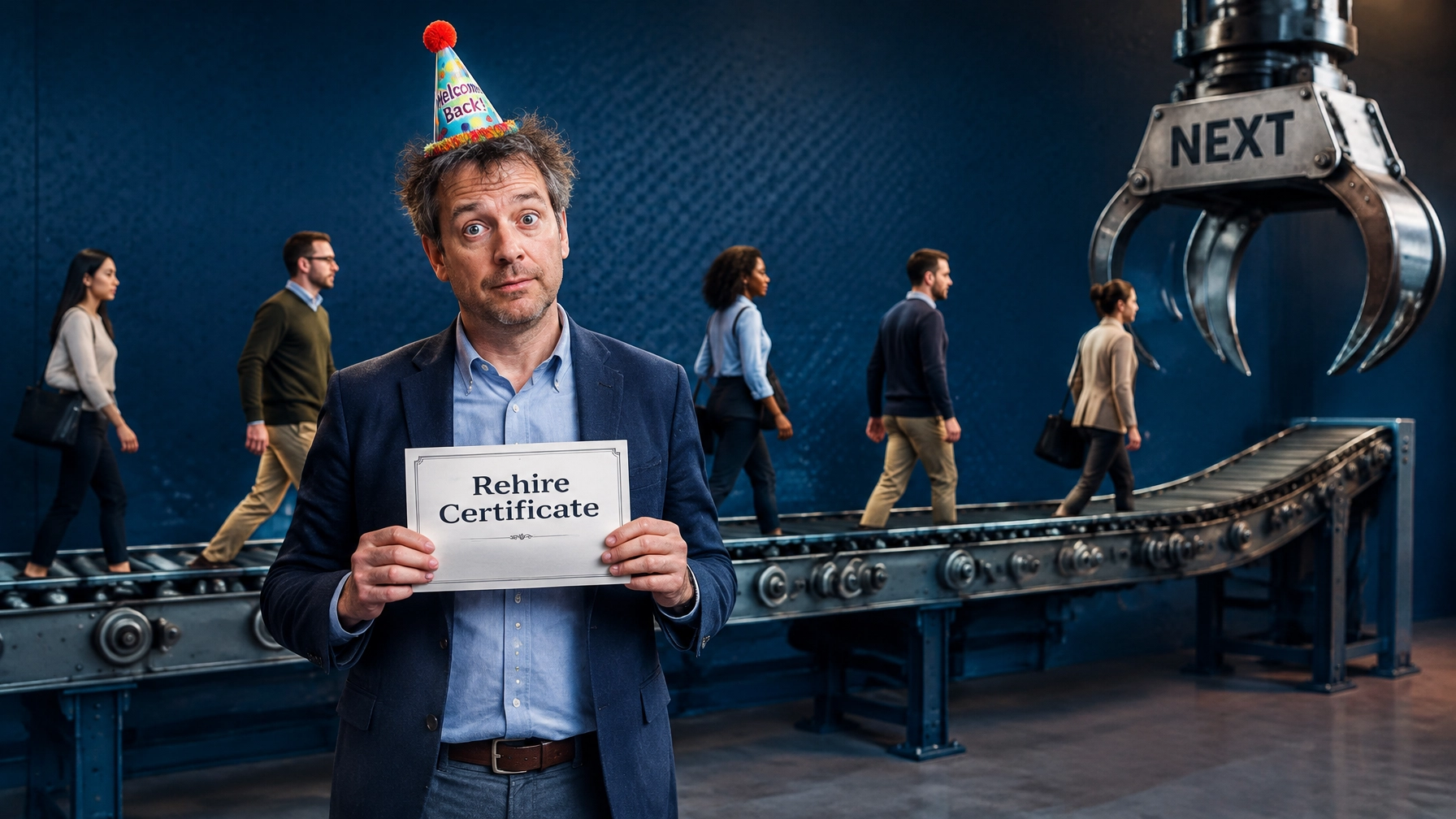
The conveyor belt in the hero image is absurd. The employment pattern it represents is not. A person loses a job, searches longer, accepts a new role, and finds that the new role may be exposed to much the same technological pressures as the old one.
That is what makes “re-queueing” a useful way to think about reemployment. You are back in the line, not necessarily out of it. The research describes a tendency, especially among older workers, not a rule, and certainly not proof that the next job will disappear.

The practical response is not to panic or assume every job is doomed. It is to assess your options while you still have time to choose. That could mean retraining, moving to a less exposed role, negotiating a different work arrangement, or exploring business ownership. No single path fits everyone.
Why Ownership Beats Re-Queueing
Corporate employment can provide a paycheck, benefits, and a team. It can also leave workers with little control over restructurings. When a position disappears, the employer’s decision can erase a worker’s role and future earnings at that company; it does not create business equity for the employee.
Owning a business changes the structure. In a franchise, you operate under a brand and system, and may build equity and direct customer relationships. You also take on investment, operating responsibilities, and the risk that the business does not perform as hoped. Ownership is not a guaranteed escape from AI, layoffs, or uncertainty; it is a different set of risks and responsibilities.
The right franchise opportunity depends on your capital, goals, location, schedule, and appetite for hands-on work. A franchise for sale is not automatically a good fit because its category seems resilient or its pitch sounds persuasive. And “best franchises to own” is not a universal ranking: the best match for you is the one that stands up to independent scrutiny and fits your circumstances.
A franchise consultant can help you organize the search and compare possibilities. At FranLift, we help candidates explore franchise opportunities and make introductions to brands. Our service costs candidates nothing because franchisors cover our costs from their marketing budgets. That support can make the search easier; it does not replace your own due diligence or professional advice.
How To Investigate With Evidence (Before Any Pitch)
If you are researching how to buy a franchise, start with your own numbers, not a sales presentation. Define how much you can invest without jeopardizing your household finances, how much working capital you need to retain, and whether you expect to operate the business yourself. Include fees, equipment, build-out, hiring, debt payments, and a realistic runway for reaching stable operations.
Then review the Franchise Disclosure Document (FDD) carefully. Examine the initial and ongoing fees, litigation and bankruptcy disclosures, required purchases, territory terms, franchisor support, and the rules for renewal, transfer, or termination. Under the FTC’s Franchise Rule, franchisors generally must provide the FDD at least 14 days before you sign or pay the franchisor or an affiliate. Read the FTC Consumer Guide to Buying a Franchise and the FTC Franchise Rule Compliance Guide.
If the FDD includes an Item 19 financial performance representation, check what it actually measures, which outlets it includes, and which costs may not be reflected. Revenue is not profit, and a disclosed result is not a promise about your future performance.
Speak with current and former franchisees listed in the FDD. Ask about opening costs, staffing, training, customer demand, ongoing expenses, support, and what they wish they had investigated before signing. Talk with an accountant about the financial assumptions and a franchise attorney about the agreement, territory, and exit terms. The SBA Franchise Directory may help you check whether a brand is listed for SBA financing purposes; listing is not an endorsement or a guarantee of financing or business success.

Start A Conversation With FranLift
Yesterday we covered why AI didn't take the job so much as it took the door to it; today's research shows what happens to the people who squeeze back through. The pattern is the same, and it repeats: read the previous article here.
A layoff can be a reason to review your options, not a reason to rush into a major investment. If you want to understand whether franchise ownership fits your goals, learn why FranLift or start a conversation. We can help you explore possibilities, but the decision, and the due diligence, remain yours.
THERE IS NO GUARANTEED INCOME. Past results, where disclosed, do not guarantee future performance.
This content is for informational purposes only and is not financial, legal or tax advice.
© 2026 FranLift. Launch Beyond Boundaries.
