

Launch Beyond Boundaries.
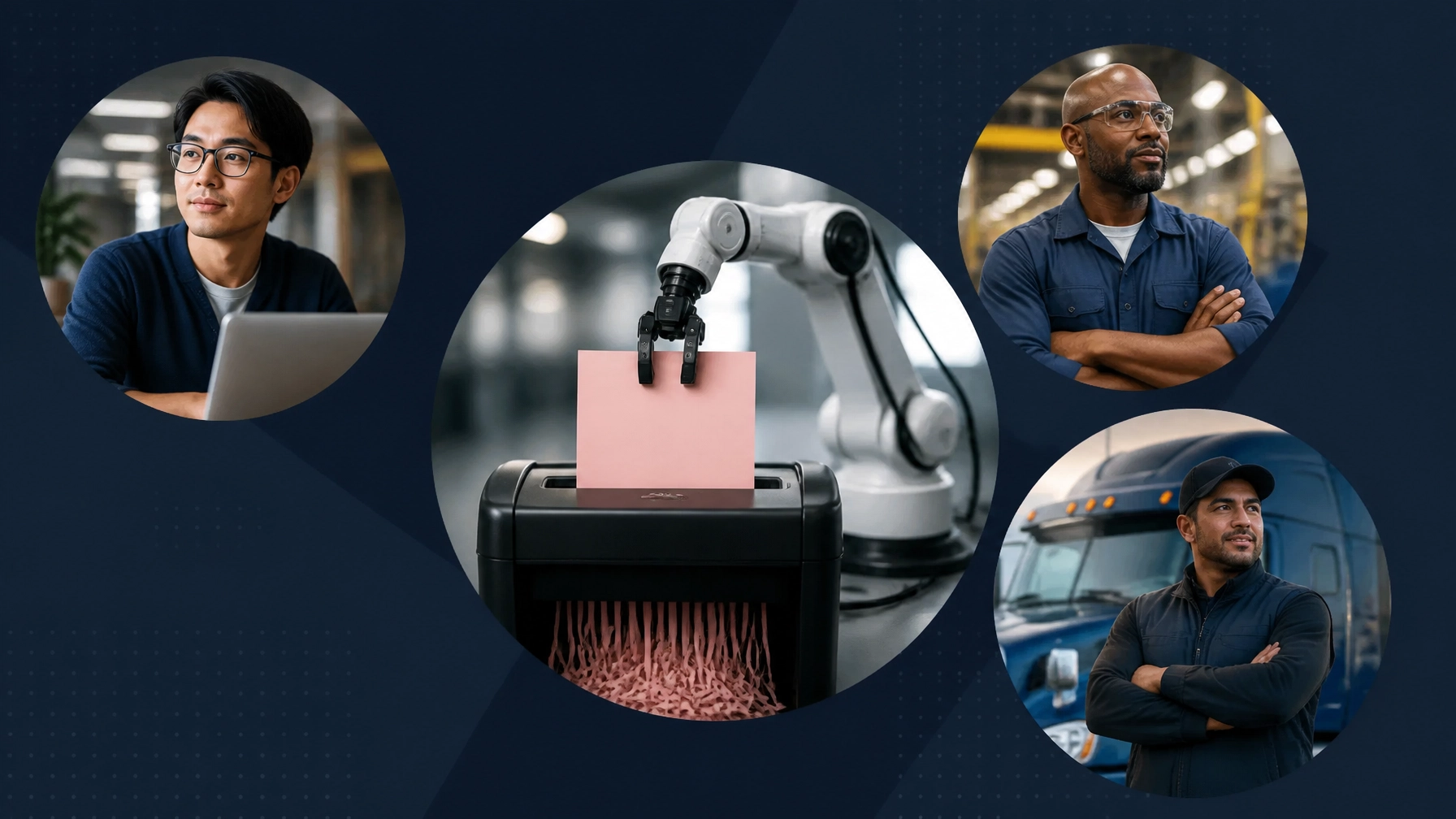
Your job can be valuable today and replaceable tomorrow.
That is the uncomfortable reality facing workers in IT, coding, manufacturing, logistics, and trucking. Artificial intelligence does not need to eliminate an entire occupation to damage your career. It only needs to automate enough daily tasks for an employer to hire fewer people, freeze entry-level openings, restructure departments, or reduce compensation.
The machine does not always arrive with a termination letter. Sometimes it quietly removes the next job opening.
For workers who want more control over their income and professional future, franchise ownership offers a structured path into business ownership. It is not risk-free or “AI-proof.” It is a way to convert technical, operational, and customer-service experience into an asset you can operate, improve, and potentially expand.
The Hard Truth: AI Exposure Is Already Reshaping Work
The most useful question is not, “Will a robot take my job?”
Ask instead: How many people will my employer need after software, robotics, and autonomous systems handle the repetitive parts of my work?
That question is already producing measurable consequences.
A Stanford Digital Economy Lab analysis reported that employment among workers ages 22 to 25 in highly AI-exposed occupations was approximately 19% below the level expected based on employment trends in less-exposed occupations. That does not mean AI has erased 19% of every job. It does show that entry-level pathways into exposed fields are narrowing.
The broader picture is more nuanced. SHRM research found that 15.1% of U.S. employment involves occupations where at least half of tasks may be automated. Only a smaller portion: about 6% of employment: falls into the highest near-term displacement-risk category. Most jobs are changing before they disappear.
That distinction matters. Career disruption often begins with fewer promotions, smaller teams, slower hiring, and greater pressure on the remaining workers.

IT And Coding: The Code Still Runs, But Fewer People May Write It
Software development is not disappearing. The economics of software production are changing.
AI tools can generate routine code, write documentation, create basic tests, identify common bugs, and accelerate application development. Experienced architects, cybersecurity specialists, systems integrators, and technical leaders may become more valuable. Roles built primarily around repetitive implementation may become less valuable.
The U.S. Bureau of Labor Statistics projects a 6% decline in computer programmer employment from 2024 through 2034, even as broader computer and mathematical occupations are projected to grow.
Your technical knowledge may remain useful while your job description becomes obsolete.
That is the real threat for many developers: not immediate replacement, but the loss of bargaining power. If one experienced employee using AI can complete the work previously assigned to three junior employees, the employer may not need to eliminate the technology department. It may simply stop building the department.
Manufacturing: More Output, Fewer Repetitive Roles
Manufacturing automation has been advancing for decades. Artificial intelligence now speeds up machine inspection, predictive maintenance, production scheduling, inventory control, and quality analysis.
The International Federation of Robotics reports that the United States installed approximately 34,200 industrial robots in 2024. Robots can increase productivity, improve safety, and address labor shortages. They can also reduce the number of workers required for repetitive assembly, material handling, inspection, and reporting.
A plant does not need to close for your position to disappear. It only needs to produce the same output with a smaller team.
Manufacturing professionals often have highly transferable skills: process control, safety, scheduling, purchasing, quality assurance, labor management, and continuous improvement. Those capabilities can translate into home improvement, commercial maintenance, automotive services, equipment repair, installation, or other operationally disciplined franchise businesses.
Trucking And Logistics: Automation Has Left The Garage
Autonomous trucking remains an evolving technology, and large-scale driver displacement has not yet appeared in official employment data. But the direction is clear.
In 2025, Aurora began commercial driverless Class 8 freight operations between Dallas and Houston, hauling paid freight on public roads without a safety driver onboard. AI-supported dispatch, route optimization, warehouse automation, and fleet analytics are also changing logistics work.
The risk is not limited to drivers. Dispatchers, coordinators, planners, and administrative teams may see their responsibilities compressed into software platforms.
A trucking professional’s value, however, is broader than miles driven. It includes route knowledge, customer relationships, regulatory awareness, fleet operations, scheduling discipline, and problem-solving under pressure. Those skills can support ownership in transportation-adjacent services, fleet maintenance, mobile operations, local delivery, equipment services, and commercial support businesses.
Waiting until autonomous vehicles dominate the highway is not a career strategy. By then, the companies that moved earlier may already control the strongest opportunities.
The Pivot: Why Franchise Ownership Changes The Equation
Corporate employment gives you a paycheck. It does not give you control over automation decisions, headcount plans, restructurings, or the next executive efficiency initiative.
Franchise ownership changes your position from employee to operator.
A franchise typically includes a recognized brand, operating procedures, training, marketing systems, vendor relationships, and ongoing support. You remain responsible for execution, but you are no longer waiting for an employer to decide whether your role remains necessary.
That is not less responsibility. It is more control over where your responsibility leads.

A well-matched franchise can provide:
- A defined operating framework instead of a blank page
- Training for owners who may have no prior experience in the industry
- A way to apply project management, hiring, budgeting, and process-improvement skills
- Direct relationships with local customers and employees
- Potential to add territories or units over time
- An asset that may be transferable or sellable, unlike a single paycheck
The best franchises to own are not automatically the largest or most recognizable brands. They are the concepts that fit your available capital, market, schedule, management style, and preferred level of involvement.
A former developer may fit a business-to-business technology service. A plant manager may excel in commercial maintenance or home improvement. A trucking professional may have an advantage in fleet support, logistics, or mobile operations.
The goal is not to recreate your old job. It is to convert what you know into ownership capabilities.
Choose Resilience, Not Hype
No franchise is completely protected from technology. Any brand promising an “AI-proof” business deserves careful scrutiny.
Instead, evaluate how technology will affect the business model. A more resilient concept may use AI to improve lead follow-up, scheduling, inventory, routing, or customer service while still depending on human judgment and local delivery.
Look closely at businesses built around:
- In-person customer experiences
- Physical services delivered on-site
- Licensed or regulated work
- Urgent customer needs
- Recurring local demand
- Complex coordination
- Skilled judgment
- Community trust
A home services franchise may automate scheduling while technicians still diagnose and solve problems in person. An education franchise may use adaptive software while instructors and parent relationships remain essential. An automotive, wellness, pet care, or commercial service business may gain efficiency without eliminating the human experience customers value.
Technology should strengthen the business. It should not be the entire business.
How To Buy A Franchise Without Buying A Fantasy
If you are researching how to buy a franchise, begin with financial discipline rather than a sales presentation.
Calculate the complete investment. Include the franchise fee, equipment, vehicles, leasehold improvements, insurance, licenses, payroll, marketing, professional fees, working capital, and personal living expenses during the launch period.
Define your ownership role as well. Decide whether you want to work directly with customers, manage employees, operate a mobile business, oversee a storefront, or build toward multiple units.
Then request and review the franchisor’s Franchise Disclosure Document, or FDD. Under the Federal Trade Commission’s Franchise Rule, prospective franchisees must receive the FDD at least 14 calendar days before signing an agreement or paying the franchisor or an affiliate.
Review the document with a franchise attorney and accountant. Pay particular attention to:
- Initial investment and recurring fees
- Advertising obligations
- Training and operational support
- Territory rights
- Renewal and transfer terms
- Financial performance representations
- Closures and franchise transfers
- The franchisor’s audited financial statements
Speak with current and former franchisees. Ask what the business actually cost to launch, how long it took to stabilize, which expenses exceeded expectations, and how the franchisor responded when problems emerged.
The SBA Franchise Directory can help determine whether a brand is listed for purposes of SBA lending eligibility. Listing is not an endorsement and does not guarantee success.

Contact A Franchise Consultant Before The Next Restructuring
You do not need to search thousands of franchise listings alone.
A franchise consultant can help clarify your goals, budget, transferable skills, preferred industries, geography, and ownership role. The process can then narrow the market to franchise opportunities that better fit your circumstances.
FranLift works with prospective owners across service, home improvement, food, wellness, education, hospitality, automotive, retail, pet, and business-to-business concepts. Its matchmaking service is free to prospective franchise owners because participating franchise companies cover the cost through their franchise development budgets.
That does not replace legal, accounting, or financial due diligence. It gives you a more efficient starting point.

If your career is vulnerable to AI, do not wait for a termination notice to begin planning. Your experience in coding, manufacturing, operations, logistics, or technology may be more valuable as an ownership advantage than as a narrowly defined job function.
Contact FranLift to discuss your investment range, preferred work style, and potential franchise categories. You can also learn more about FranLift’s franchise matchmaking process.
The algorithm may be learning your job. Start building the business that puts you back in control.
© 2026 FranLift. Launch Beyond Boundaries.
