

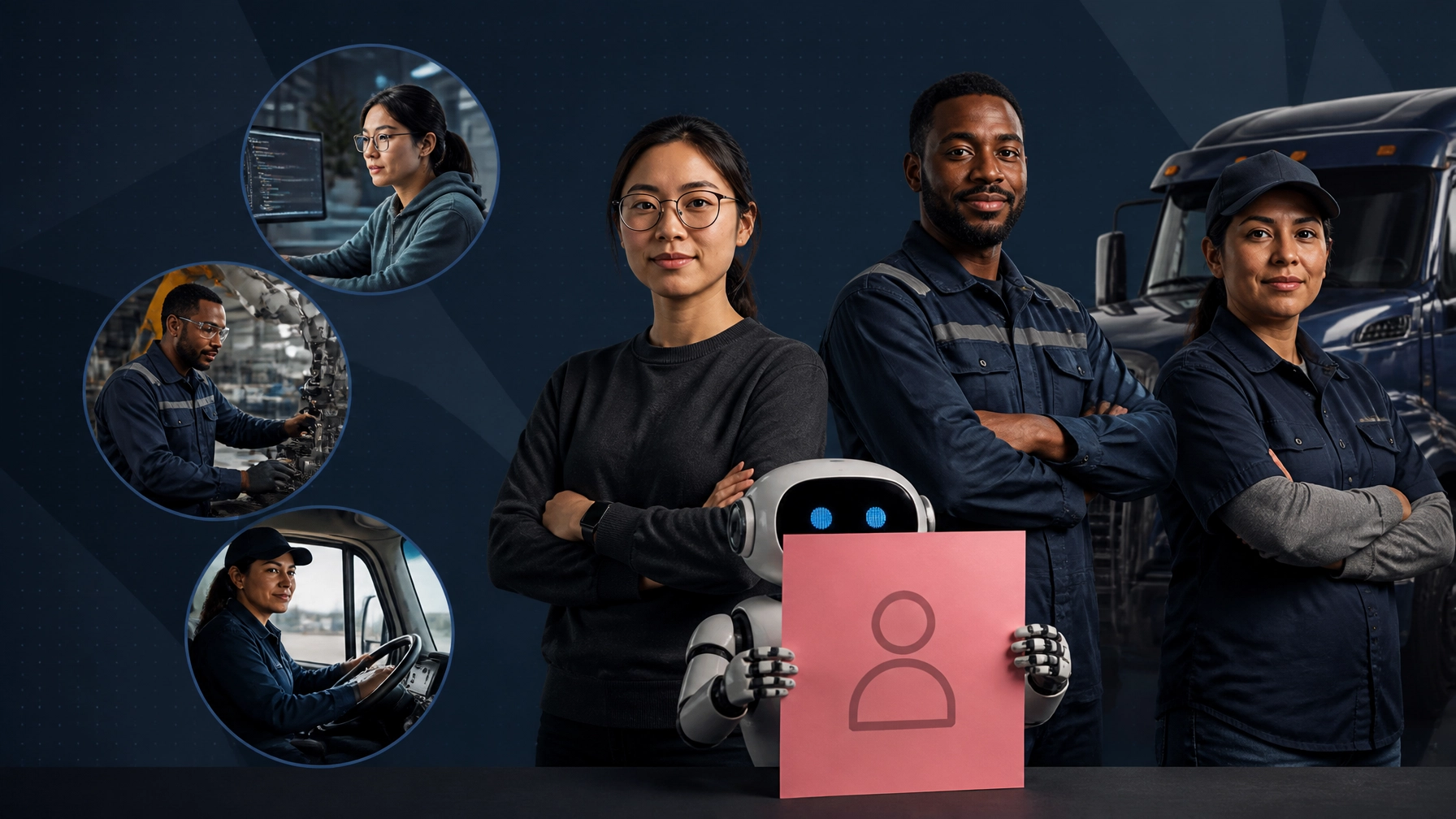
Launch Beyond Boundaries.
The question is no longer whether artificial intelligence will change your career. It already has.
If you work in IT, coding, manufacturing, logistics, or trucking, the disruption is not theoretical. Software writes routine code. Robots inspect and assemble products. Algorithms optimize routes and loads. Automation tools help companies produce more with fewer people.
Your job may not disappear tomorrow. But the tasks that justify your paycheck are being measured, automated, and redesigned today.
That creates a serious career question:
Will you continue competing for a shrinking role: or build something you control?
For many experienced professionals, franchise ownership offers a structured path from employment risk toward business ownership. It is not a guaranteed escape from market forces. It is an alternative that can help you use your skills, operate a local business, and build an asset instead of waiting for the next corporate reorganization.
The Hard Truth: AI Is Already Rewriting Employment
The loudest AI predictions are not always the most useful. The stronger warning comes from the data showing how much work is already changing.
According to SHRM research on automation and job displacement risk:
- Approximately 20% of U.S. employment: about 31.1 million jobs: has at least half of its tasks automated.
- About 21% of employment uses AI tools for at least half of its tasks.
- Computer and mathematical occupations have the highest share of employment with at least 50% of tasks automated, at 51.2%.
- Production occupations register 20.2% of employment at that automation threshold.
- Transportation and material-moving occupations register 14.4%.
- About 5.1% of U.S. employment: roughly 7.9 million jobs: faces high automation displacement risk.
These figures do not mean that 7.9 million people receive termination notices at once. Automation exposure is not the same as confirmed job loss.
But “not eliminated yet” is not the same as secure.
Goldman Sachs research estimates that AI could eventually automate tasks representing approximately 25% of all work hours in the United States. Its analysis also estimates that roughly 300 million jobs globally are exposed to AI automation over the longer term.
The pressure is especially visible in four career lanes.
IT And Coding
AI tools can generate boilerplate code, debug common errors, document systems, write tests, and produce prototypes in seconds. Senior professionals who design systems, manage risk, and lead teams may remain highly valuable.
The harder path belongs to workers whose roles depend primarily on repeatable digital tasks.
The new question is not simply, “Can you code?”
It is:
Can you create more value than the tools that now write the first draft?
Manufacturing
Automation affects assembly, packaging, inspection, inventory, and quality control. A human supervisor may still be essential, but fewer workers may be needed to produce the same output.
The factory floor is not necessarily losing every person. It is losing the assumption that more production always requires more labor.
Trucking And Logistics
AI is already used for route optimization, fleet management, dispatching, load planning, and predictive maintenance. Autonomous trucking still faces regulatory, infrastructure, and safety challenges, but the transportation industry is clearly being redesigned.
The truck may still need a driver today.
The business model may need fewer drivers tomorrow.
Corporate Employment
Even when AI does not replace a position directly, it can reduce hiring, consolidate departments, and raise productivity expectations. A team that once needed ten people may be expected to deliver with six.
Your title may survive while your bargaining power disappears.

The Pivot: Why Franchising Can Beat Waiting For A Corporate Rescue
Franchise ownership does not make risk disappear. It gives you a different type of risk: one you can evaluate, influence, and potentially build equity in over time.
Corporate employment gives you a paycheck in exchange for labor. A franchise gives you the opportunity to operate a business supported by a defined brand, established processes, training, and ongoing systems.
That distinction matters when technology is changing the value of labor.
The U.S. Census Bureau’s overview of franchising reported nearly half a million franchise establishments in the industries covered by its Economic Census data, generating substantial sales and employment across the country.
Franchising is not limited to restaurants. Current franchise opportunities span home services, wellness, education, automotive, pets, logistics, retail, hospitality, and professional services.
You Control More Of The Operating Decisions
As an employee, you can recommend a better process and still be overruled by a distant executive team. As a franchise owner, you operate within a proven system while making local decisions about staffing, customer service, scheduling, marketing, and growth.
You are not inventing every process from scratch. You are responsible for executing the business in your market.
That is a meaningful change. Instead of waiting for a company to decide whether your role remains necessary, you are building an operation where your judgment affects the outcome.
You Can Move Toward Human-Centered Demand
The best franchises to own in an AI-disrupted economy are not necessarily the businesses with the most technology. They are often businesses where customers still value trust, physical presence, judgment, and accountability.
Potential categories include:
- Home improvement and maintenance
- Cleaning and property services
- Automotive services
- Health, wellness, and personal care
- Pet care
- Education and tutoring
- Local logistics and operational services
- Food and hospitality
These businesses are not immune to automation. They can use AI for scheduling, marketing, customer communication, inventory, and reporting.
But the core customer experience may still require people in the community doing real work.
The strategic advantage is simple:
Use AI to run the business more efficiently instead of allowing AI to define your entire economic value.
Your Existing Skills Still Matter
An IT professional may bring process discipline, systems thinking, and data fluency.
A manufacturing professional may understand quality control, throughput, staffing, and operational efficiency.
A truck driver may bring logistics knowledge, route awareness, equipment familiarity, and customer reliability.
Those skills can transfer into franchise operations: even when the franchise is in an industry where you have no prior experience. FranLift notes that many franchisees enter industries completely new to them because franchisors provide training and repeatable operating models.
The goal is not to duplicate your old job.
It is to convert your experience into ownership leverage.

How To Buy A Franchise Without Guessing
Searching for a franchise for sale online is easy. Choosing a business that fits your finances, goals, risk tolerance, and preferred role as an owner is much harder.
Before reviewing franchise opportunities, clarify five factors.
Assess Your Capital
Identify your liquid funds, available reserves, working capital, financing options, and personal expenses. A franchise requires more than the initial franchise fee. You must plan for equipment, real estate, marketing, payroll, insurance, and the time required to reach consistent revenue.
Never invest money you cannot afford to risk.
Define Your Owner Role
Decide whether you want to operate the business daily, manage a team, or pursue a semi-absentee model where appropriate. Some franchise concepts require significant owner involvement. Others are designed around management teams or mobile operations.
The right opportunity must fit the way you actually want to work.
Evaluate Your Market
Local demand, competition, demographics, labor availability, territory restrictions, and customer acquisition costs all matter. A strong brand cannot compensate for a poor market fit.
Ask what customers in your area need repeatedly: not just what appears popular online.
Identify Transferable Skills
List the operational strengths you already possess. Can you manage people? Improve workflows? Control costs? Build customer relationships? Track performance? Solve problems under pressure?
These capabilities may be more important than direct industry experience.
Complete Independent Due Diligence
A franchise is not a guaranteed investment. Review the Franchise Disclosure Document with qualified legal and financial professionals. Speak with current and former franchisees. Understand royalties, renewal terms, territory rules, required suppliers, marketing fees, and exit conditions.
A franchise consultant can help you compare brands, eliminate poor fits, coordinate introductions, and organize next steps. A good consultant does not simply push one brand. The value is in narrowing a large market into opportunities that deserve your attention.

Put Yourself Back In The Driver’s Seat
AI is changing employment faster than many workers can comfortably respond.
You do not have to wait for a replacement notice to begin planning.
Franchise ownership can provide a structured path toward independence for professionals in coding, IT, manufacturing, and trucking who want to apply their experience in a business they can help shape. It requires capital, discipline, research, and a willingness to carry responsibility.
Continuing to rely on a single employer carries risk too: especially when that employer can deploy software, robotics, or automation at scale.
Do not search blindly for the “best franchise to own.”
Find the best franchise for your financial position, skills, market, and life.
FranLift helps prospective owners compare more than 4,000 franchise concepts across service, home improvement, automotive, education, wellness, hospitality, food, retail, and pet industries. Its franchise matchmaking process starts with your goals, budget, lifestyle preferences, and ownership expectations.
The service is free to prospective franchise owners because participating franchise companies cover the cost through their franchise development budgets. You should still conduct independent research and seek professional advice before making a commitment.
Ready to evaluate your options? Contact a FranLift franchise consultant to discuss franchise opportunities, financing considerations, and the next step in your ownership search.
The future of work is being automated.
Your future does not have to be dictated by it.
© 2026 FranLift. Launch Beyond Boundaries.
