

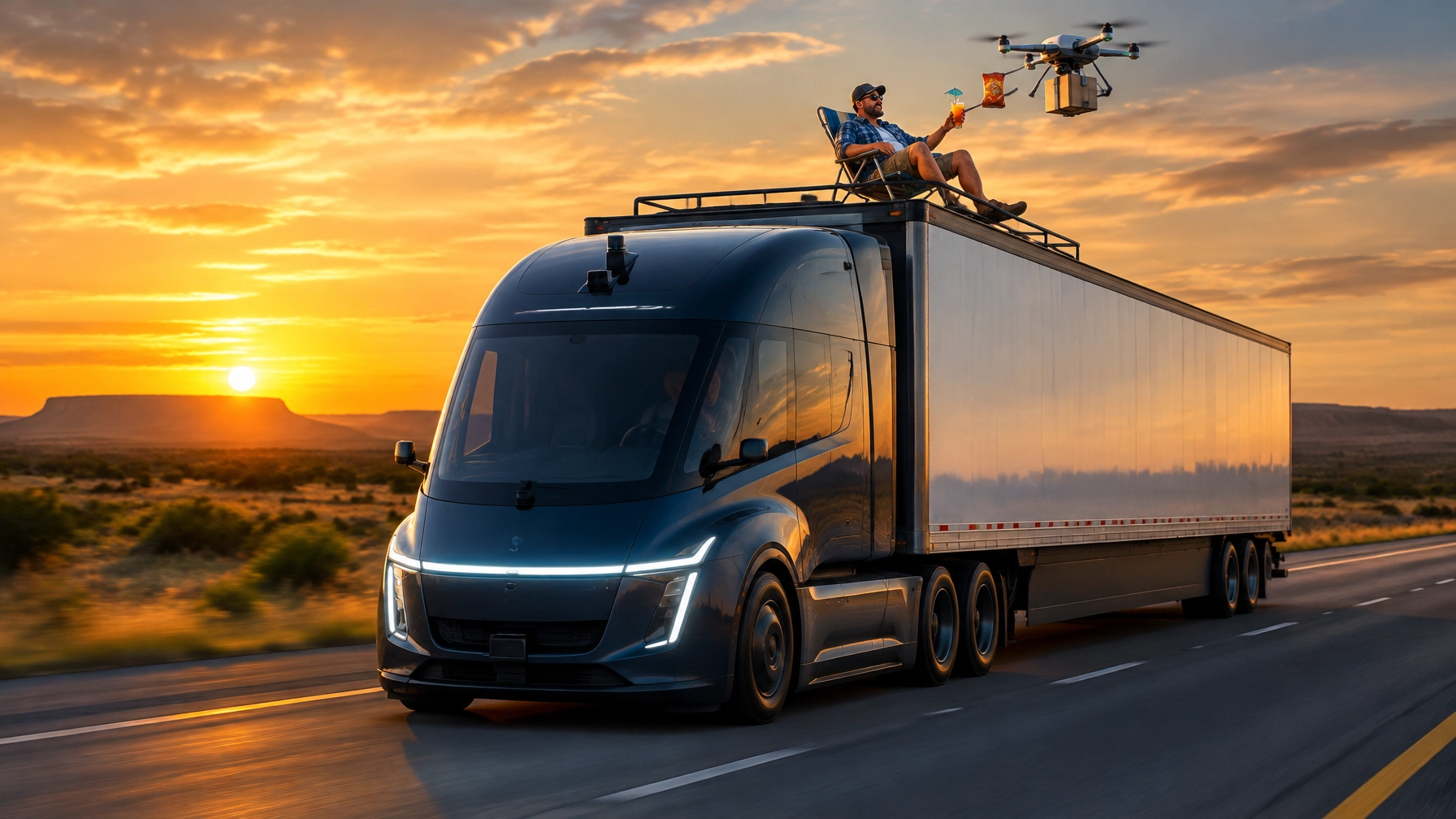
On May 1, 2025, Aurora Innovation announced that an autonomous semi had begun hauling customer freight between Dallas and Houston on public roads, with no human in the cab. It was a real route, real cargo, and real commercial service. The truck arrived ahead of the panic. The panic never really showed up.
That silence is the surprising part. The technology was no longer a trade-show promise, but the public conversation did not turn into a countdown clock for every driving job. The better question is not whether autonomous trucking exists. It does. It is how quickly it can expand, and what that measured transition means if you are weighing your career, finances, or a business purchase.
The Truck Actually Works
Aurora announced its Dallas–Houston service as the first U.S. commercial self-driving service using heavy-duty trucks on public roads. Its launch customers included Uber Freight and Hirschbach Motor Lines, moving goods along a defined corridor, not merely circling a test track.
By the end of April 2026, Aurora reported more than 370,000 cumulative driverless miles. In its first-quarter 2026 shareholder letter, the company also said trucks it was operating for Werner were averaging more than 4,000 miles per week. That is a meaningful operating signal: the vehicles are doing commercial work and building utilization, not just collecting demonstration miles.
Those numbers deserve to be taken seriously. They also need context. Aurora’s technology is designed to operate within defined conditions and routes, and the company’s own letter describes the considerable work still needed to expand service: validating hardware and software, opening routes, handling customer facilities, and establishing the logistics required for routine operations.
Aurora’s launch materials describe redundant systems for functions including braking, steering, sensing, computing, and communications. In other words, a driverless truck is not simply a production truck with a camera and an optimistic software update. It is a complex vehicle-and-operations system. And the system must perform reliably in the real world, where a highway can include construction, severe weather, a fuel stop, a crowded yard, and an unexpected detour.

So Where Are The Layoffs?
One reason the public mood has not become “robot trucks are taking every job” is that the scale of deployment remains far smaller than the scale of the trucking market.
AEI’s James Pethokoukis, writing about robot trucks and AI jobs on September 28, 2026, points to a projection from JPMorgan: more than 30,000 autonomous trucks could be on the road by 2030. Even if that bullish estimate were reached, AEI notes, it would cover only about 1.9% of long-haul trucking miles in the addressable market.
That 1.9% is not a prediction that nothing will change. It is a useful scale check. It separates a countdown-clock story (“the whole occupation disappears next”) from a market-share story: a technology gains ground in a specific part of an enormous industry, over time.
Pethokoukis’s central point is about the distance between a promising technology and a scaled operating fleet. Forecasts can count potential vehicles while overlooking manufacturing capacity, component supply chains, hardware production, deployment logistics, and the slow work of moving from a pilot route to a functioning network. A truck fleet needs more than trucks. It needs the equipment, maintenance, insurance, terminals, routes, customer integrations, and operating procedures to make those trucks useful.
Aurora’s own plans illustrate the difference between ambition and industrial readiness. In its Q1 2026 letter, the company said it was working with PACCAR to define a path to a scalable launch of a third-generation Aurora Driver hardware kit integrated with PACCAR’s future autonomy-enabled platform on assembly lines. That is progress, but it also means the hardware path was still being defined, rather than already standardized and rolling off production lines at massive scale.
This is why some displacement forecasts missed the practical bottlenecks. The technology can work on a route before it can economically, reliably, and operationally serve a large share of routes. A commercial milestone is not the same thing as a mass-market replacement.
Read The Clock Correctly
The counterargument matters: slow does not mean stalled. Aurora says its driverless miles are increasing, and the 4,000-plus weekly miles reported for Werner trucks are evidence of growing utilization. A business does not need to replace every truck to change particular lanes, schedules, or roles. The timeline is measured in years, not necessarily decades.
But treat the numbers as evidence, not prophecy. The 30,000-truck figure is a JPMorgan projection cited by AEI, not a law of nature. The 1.9% estimate concerns one company’s projected fleet against an addressable-market measure. It is not a guarantee that adoption will stop there, or that every type of driving work faces the same timetable.
Adoption curves are shaped by less glamorous constraints: producing hardware consistently, servicing it across operating regions, insuring it, coordinating with shippers and carriers, and getting vehicles through terminals and customer yards. Aurora’s own shareholder letter discusses ongoing work on commercial hardware, route expansion, dynamic rerouting, and operations at customer facilities. These are not signs that the idea has failed. They are signs that scaling a complex system takes more than a working demo.
And long-haul trucking is only one slice of driving work. The same caution applies to automation forecasts in both directions: headlines can exaggerate how quickly jobs change, but early market-share figures can also understate how much change may eventually follow. Workers deserve neither panic nor false reassurance. Business buyers deserve the same balanced view.
The practical conclusion is not “ignore the robot truck.” It is “understand the pace, the limits, and the risks, and make decisions with enough time to adapt.”
Why Slow Timelines Favor Buyers Who Move Early
If you work in trucking or logistics, you already know how much the job involves beyond steering. Routes, dispatch, scheduling, fleet utilization, customer expectations, safety procedures, and operational problem-solving are transferable skills. They can be relevant in many service businesses, including franchise models that depend on consistent scheduling, field teams, vehicles, or repeat customer relationships.
Exploring a business does not mean quitting your job tomorrow, borrowing beyond your comfort, or betting against your industry. It means giving yourself time to investigate options while you still have choices. If automation or other changes affect your role, you may want a second income stream, a gradual transition, or a longer-term path to ownership. Starting research early gives you room to compare those possibilities with your actual finances and preferred lifestyle.
Franchise opportunities can offer an established operating model, training, and ongoing support, but they also come with obligations, costs, and risks. A franchise is not a guaranteed escape from economic change. Some brands depend heavily on vehicles, specialized equipment, software, or subscriptions; those requirements can change during an agreement. The useful question is not simply “Is this brand popular today?” It is “How resilient is this operating model, and what will I be required to invest in over time?”
That kind of scrutiny matters whether you are looking for a franchise for sale, comparing what might be among the best franchises to own for your circumstances, or simply testing whether ownership is right for you. Popularity is not a substitute for fit.
How To Buy A Franchise With Evidence
A sound decision starts with the documents and people who can explain how the business actually works. The FTC’s Consumer Guide to Buying a Franchise is a useful introduction. The FTC’s Franchise Rule Compliance Guide explains the disclosure framework.
Under the FTC Franchise Rule, a franchisor generally must provide the Franchise Disclosure Document (FDD) at least 14 calendar days before you sign a binding agreement or pay the franchisor or an affiliate. Use that time to read, not just skim, the details. In particular, review:
- Items 5–7 for initial fees and estimated initial investment.
- Item 11 for training, support, required computer systems, and technology subscriptions.
- Item 12 for territory terms and limitations.
- Item 19 for any financial performance representations and their limits. A brand is not required to make these representations; if it does not, do not treat other anecdotes as a substitute.
- Items 20–21 for outlet history and the franchisor’s financial statements.
Talk with current franchisees and, where possible, former franchisees. Ask what the day-to-day work looks like, what surprised them about costs, how responsive support is, and what they wish they had clarified before signing. An independent franchise attorney and a qualified financial professional can help you assess the agreement, obligations, and financial assumptions. They work for you, not the brand.
You can also search the SBA Franchise Directory. The SBA states that inclusion is not an endorsement or approval and does not ensure a business will succeed. Treat the directory as one reference point, not a recommendation.
For equipment-dependent brands, ask directly how required vehicles, equipment, computer systems, and software may change over the full agreement term. Who pays for upgrades or replacements? Are there required suppliers? What happens if a system becomes obsolete or a new standard is introduced? A purchase decision should account for the business you will be required to operate tomorrow, not only the one described in today’s sales conversation.

Start A Conversation With FranLift
A franchise consultant can help you compare opportunities against your goals, budget, experience, and preferred role in the business. At FranLift, buyer services are free because franchise companies cover our costs as part of their marketing budgets. You can learn why FranLift or contact our team to start a conversation.

The truck is real. So is the uncertainty about how fast the industry will change. You do not need to predict the future perfectly to prepare for it. You need evidence, time to compare your options, and a plan that fits your own life. Build your next chapter with room to grow beyond the horizon.
THERE IS NO GUARANTEED INCOME. Past results, where disclosed, do not guarantee future performance.
This article is for informational purposes only and is not financial or legal advice. Consult qualified independent professionals before making financial or legal decisions.
© 2026 FranLift. Launch Beyond Boundaries.
