


Launch Beyond Boundaries.
Your job can be valuable today and replaceable tomorrow.
That is the uncomfortable reality facing workers in IT, coding, manufacturing, logistics, and trucking. Artificial intelligence does not need to eliminate an entire occupation to damage your career. It only needs to automate enough of your daily tasks for an employer to need fewer people, restructure your role, or reduce its compensation.
The more urgent question is not whether AI will affect your work. It is whether your entire income will remain dependent on an employer whose automation strategy you cannot control.
For many experienced workers, franchise ownership offers a practical pivot. It can convert professional experience into a local business you operate, influence, and potentially expand. It is not an escape from work or a guaranteed path to wealth. It is a different structure for building income and ownership.
The Hard Truth: AI Is Changing The Value Of Work
The loudest predictions about AI are often too extreme. Not every job will disappear. But workers should not mistake “your occupation still exists” for “your current role is safe.”
The 2026 SHRM research on automation and job displacement risk estimates that approximately 20% of U.S. wage and salary employment is currently at least 50% automated at the task level. Only about 5.1%, or 7.9 million jobs, currently face high displacement risk because many occupations still include nontechnical barriers such as physical presence, regulation, judgment, and human trust.
That distinction matters. AI can change your job long before it removes your job.
Goldman Sachs Research estimates that 6% to 7% of the U.S. workforce could eventually be displaced if AI adoption becomes widespread. Its analysis identifies computer programmers, administrative assistants, customer service representatives, accountants, and related roles among the occupations with greater exposure.
At the same time, PwC’s 2025 Global AI Jobs Barometer, based on nearly a billion job advertisements, found that the skills requested in AI-exposed jobs are changing 66% faster than in less-exposed roles. Workers may keep their titles while their required capabilities shift underneath them.
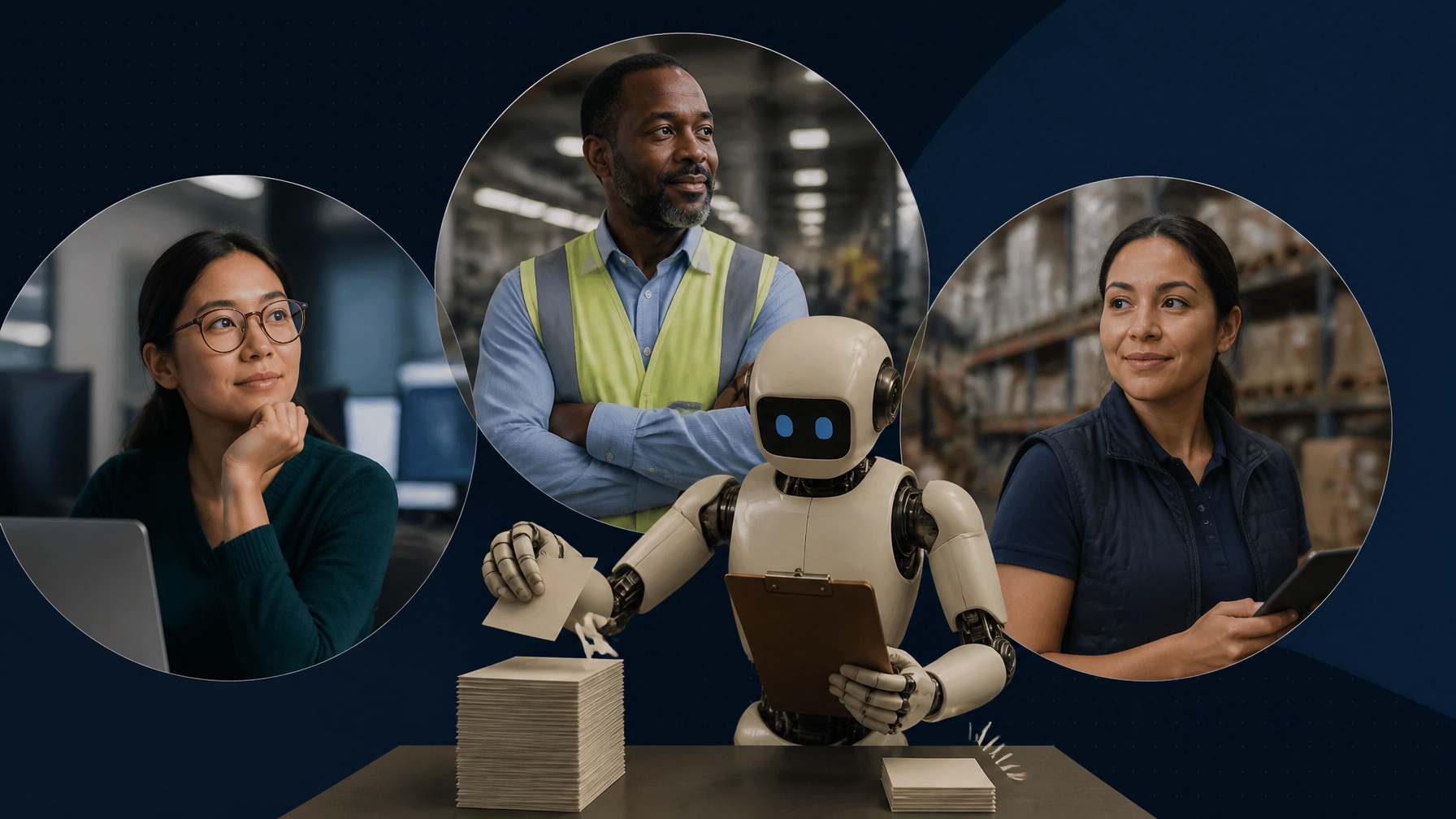
That is the real threat: not a robot dramatically marching into your office, but a quiet rewrite of the job description.
IT And Coding: The Routine Layer Is Under Pressure
Software development is not disappearing. High-level architecture, cybersecurity, systems integration, product strategy, and technical leadership remain valuable.
The pressure is concentrated lower in the stack. Routine coding, basic testing, documentation, debugging, data processing, and simple application development can increasingly be completed or accelerated by AI tools.
The U.S. Bureau of Labor Statistics projects a 6% decline in computer programmer employment from 2024 to 2034. That does not mean every programmer is headed for unemployment. It does mean workers whose value is tied primarily to repetitive implementation may face a shrinking market.
Your technical experience may remain relevant. Your current job description may not.
Manufacturing: More Output With Fewer People
Manufacturing has already experienced decades of robotics, automated inspection, predictive maintenance, digital scheduling, and process optimization. AI accelerates the same pattern.
A facility does not need to close for workers to lose leverage. It may simply produce more with fewer employees. Inspection, inventory management, reporting, production planning, and repetitive assembly are all areas where software and machines can compress labor requirements.
Manufacturing professionals who understand safety, quality control, scheduling, equipment, process discipline, and team leadership may be positioned to move into ownership. But waiting until a plant announces its next automation initiative is not a transition plan.
Trucking And Logistics: The Risk Is Broader Than Driving
Autonomous trucking remains a developing technology, and widespread driver replacement has not occurred. But logistics is already being reshaped by route optimization, automated dispatch, warehouse robotics, fleet analytics, and AI-supported scheduling.
The exposure extends beyond drivers. Dispatchers, planners, coordinators, and administrative logistics workers may see routine responsibilities consolidated into software platforms.
The danger is not necessarily that every truck will become driverless next year. The danger is that the industry can require fewer people to coordinate the same volume of work.
The Pivot: From Employee Exposure To Business Ownership
Corporate employment can provide stability, benefits, and professional growth. But it concentrates your income in one employer’s priorities.
A change in leadership, budget, software, investor expectations, or workforce strategy can affect your position even if your performance remains strong. You may have responsibility without control.
Franchise ownership changes that equation. You operate a local business within an established system, serve multiple customers, manage people, execute marketing, and make decisions that directly affect the operation.
That does not eliminate risk. It makes the risk more visible and more actionable.

A franchise may provide:
- A defined operating model
- Brand standards and marketing guidance
- Training and launch support
- Supplier and technology relationships
- A network of other franchise owners
- A potential path toward additional locations
In exchange, you invest capital, follow system requirements, pay royalties and other fees, and accept responsibility for execution.
The best franchises to own are not necessarily the biggest or most recognizable brands. They are the concepts that fit your capital, market, skills, schedule, and preferred ownership role.
A former developer may evaluate managed IT services, cybersecurity, digital services, technology education, or business process franchises. A manufacturing leader may bring strong transferable skills to commercial maintenance, home improvement, automotive, equipment service, signage, or industrial support. A trucking professional may understand fleet services, mobile repair, logistics coordination, moving and storage, or business-to-business delivery better than a first-time operator.
You do not need to recreate your old career. You need to identify the capabilities your old career gave you and apply them to a business you can influence.
Choose A Franchise That Can Use AI Without Depending On AI
No franchise is completely protected from technology. The better question is whether AI strengthens the business or replaces its entire value proposition.
Businesses built around physical service, local reputation, recurring needs, skilled judgment, and human relationships may have more resilience than businesses based only on repetitive digital tasks.
A home services franchise can use AI for lead follow-up and scheduling while technicians still solve problems at a customer’s property. An education franchise can use software to personalize instruction while instructors and parent relationships remain central. An automotive, pet care, wellness, senior care, or commercial service business can automate administration without eliminating the trust customers value.
The goal is not to find an “AI-proof” business. That promise should make you skeptical. The goal is to own a business where technology improves productivity while human judgment, physical presence, and local relationships continue to create value.
Ownership also lets you use AI differently. Instead of worrying only about whether AI will replace your tasks, you can evaluate how it might improve marketing, customer communication, scheduling, inventory, reporting, and employee training.
You own the decision about how the tool is deployed.
How To Buy A Franchise Without Buying A Fantasy
If you are researching how to buy a franchise, begin with financial clarity rather than a sales presentation.
Calculate the full investment, including:
- Initial franchise fee
- Equipment and vehicles
- Real estate or leasehold improvements
- Insurance and licensing
- Payroll and recruiting
- Marketing and technology
- Professional fees
- Working capital
- Personal living expenses during launch
The Federal Trade Commission’s guide to buying a franchise explains that the franchisor must provide a Franchise Disclosure Document, or FDD, at least 14 calendar days before you sign or pay. The FDD contains 23 disclosure items covering costs, litigation, obligations, financial performance claims, franchisee turnover, and the franchisor’s financial condition.
Read it with independent professionals.
Pay close attention to Item 7, which outlines the estimated initial investment. Compare those assumptions with actual local costs. Item 19 contains any financial performance representation the franchisor chooses to make; revenue is not profit, and averages can conceal weak locations. Item 20 provides information about franchise openings, closures, transfers, and franchisee contacts.
Speak with current and former owners. Ask what they invested, how long it took to stabilize operations, which costs exceeded expectations, whether the franchisor delivered the promised support, and what they would do differently.
A franchise attorney should review the agreement. An accountant should test the financial assumptions. A lender’s approval is not proof that a business is suitable for you.

Work With A Franchise Consultant Before You Need A New Career
Searching every franchise for sale on the internet can create the illusion of progress while producing very little clarity. A larger list is not necessarily a better list.
A qualified franchise consultant begins with your circumstances: available capital, credit position, location, career history, transferable skills, desired schedule, income goals, and willingness to manage employees or operate directly.
The consultant can then narrow thousands of franchise opportunities into a shortlist worth investigating. The process should include brand introductions, questions to ask, financial considerations, and connections to franchise attorneys and funding partners.
FranLift helps prospective owners evaluate franchise opportunities across service, home improvement, food, wellness, education, hospitality, automotive, retail, pet, and business-to-business categories. The process is free to prospective franchise buyers because participating franchise companies cover the cost through their franchise development budgets.
That service does not replace due diligence or independent advice. It gives you a more disciplined place to start.

If your work is exposed to AI, do not wait for a termination notice to begin planning. Your experience in coding, manufacturing, operations, logistics, or technology may be more valuable as an ownership foundation than as a narrowly defined job function.
Contact FranLift for a free consultation to discuss your background, location, investment range, and preferred work style. You can also learn more about FranLift’s franchise matchmaking process.
AI is changing the employment landscape. Build your next move before the algorithm builds it for you.
© 2026 FranLift. Launch Beyond Boundaries.
