

AI & Automation | Post 49 Of 100 | November 24, 2026 | 7:00 AM
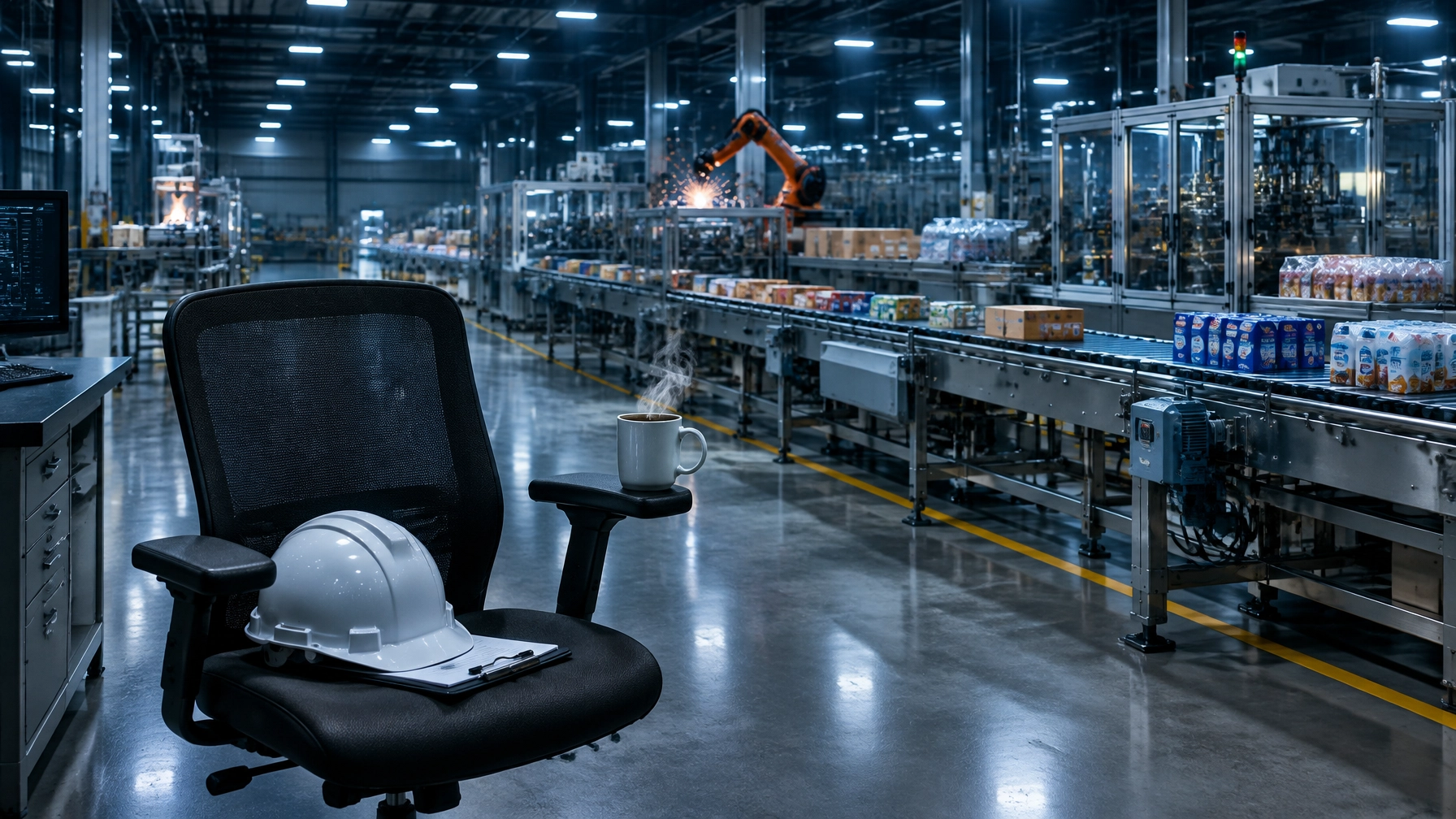
A “dark shift” is a factory shift that runs with nobody on the floor. It is no longer a pilot. Procter & Gamble said on November 19, 2026, that 15 sites worldwide already run shifts without human intervention, more are planned for 2027, and the company intends to reduce its product-supply workforce by 20% to 30% by 2030.
About 65,000 workers, including contractors, are in that workforce category: manufacturing, purchasing, planning, engineering, and quality control. This is not a layoff announcement. It is a target date.
The productivity arithmetic behind it deserves scrutiny. Labor productivity can rise because a company makes more with the same hours. It can also rise when the company removes hours. The second route may require no breakthrough in technology at all. As University of Toronto associate professor Kristina McElheran put it, “Cutting head count, as Procter & Gamble has done, mechanically improves labor productivity without transforming much of anything.”
A Productivity Target Is A Calendar
At a November 19 investor presentation in Cincinnati, P&G chief product supply officer Luc Reynaert said, “We are taking unattended operations to a whole new level.” The company’s first unattended shift ran at a Gillette factory in Berlin in 2024. P&G now says 15 sites can operate shifts without human intervention, mostly overnight, and it plans to expand the approach in 2027. The company expects unattended operations to raise manufacturing productivity by up to 20% over the next four years.
P&G has also deployed autonomous robots at loading docks and in warehouses and experimented with driverless trucks. CFO Andre Schulten set a target of up to $10 billion in productivity savings across fiscal years 2027 through 2030, including up to $1.8 billion annually from cost of goods sold. The company says automation, digitization, and unattended shifts helped deliver record productivity gains and $2.8 billion in savings in fiscal 2026, offsetting higher raw-material, energy, and freight costs. The workforce reductions, a spokeswoman said, have been underway for several years through the Supply 3.0 program. They follow up to 7,000 office jobs eliminated in 2025 under a two-year restructuring.
Executives have said unattended shifts can improve schedules by moving workers away from hard-to-staff overnight work and into less repetitive tasks or daytime customer-facing roles. They have also acknowledged that leaner teams will be needed. The worker who runs today’s dark shift and the worker told in five years that the site needs fewer people may be the same person. No HR system is likely to surface that connection as a warning.
The Productivity Math Has Two Sides
Labor productivity measures output per hour worked. A company can improve it by increasing output, reducing hours, or doing both. In P&G’s case, the promise of automation and the announced workforce reduction are not separate stories. They are two descriptions of the same productivity plan.

The distinction matters because the broader productivity record is not yet proof that AI and automation are delivering economy-wide gains. Bureau of Labor Statistics data released November 20 showed manufacturing labor productivity had been stagnant for more than a decade before ticking up last year. Total factor productivity, which measures how efficiently manufacturers turn labor and capital into goods, declined last year despite the investment in automation and AI. Read those two sentences together and you get the uncomfortable version of the story: the machines have not yet made American manufacturing measurably better at turning inputs into goods, but the headcount plan has already been written. Announced targets are not measured outcomes. A target date is not evidence.
“We are still waiting to see the AI age in the productivity statistics,” McElheran said. She added that “a lot of firms are announcing targets and intentions, in part to commit their resources and work forces to achieving ambitious goals that may or may not be feasible.” Brian Jacobsen, chief economic strategist at Annex Wealth Management, has questioned how much of P&G’s savings target represents new efficiency rather than a response to higher energy and freight costs, and whether reductions can be made without impairing innovation, service, or execution. In June 2026, United Auto Workers president Shawn Fain called robots replacing factory workers a “profound threat.”
The Office Shift Is Quieter
In offices, the change often arrives without a dramatic layoff announcement. It looks like a requisition that never opens, a contractor agreement that expires, or a team that handles more work without replacing departures.
Anthropic’s November 23 report, Working with AI, by Nathan Wilmers, Maxim Massenkoff, and Peter McCrory, draws on 66 in-person interviews across 58 enterprise customers. It found few examples of domestic layoffs directly caused by AI automation. Only two companies said AI had fully eliminated a position and led to someone losing a job. Five described pushing out employees who would not adopt AI; one engineering executive said the company terminated a developer who “just kind of shut down instead of trying to embrace it.”
The quieter signal was hiring. Two-thirds of the companies reported reducing hiring because of AI. One employee summarized it this way: “We may not be firing, but we’re not hiring.” A third of those hiring declines came from shrinking functions through attrition without backfilling. An engineering leader at a health management company said, “We’ve added a lot of capacity by buying tokens instead of hiring people.”
Nine companies described cutting contractors in software development, customer service, legal work, and back-office functions, many already offshored. One finance company reduced its offshore data and developer contractors by well over 100. Another company built an AI agent into document review and cut by more than 90% the reviewers it expected to hire the following year. One COO said 90% of his operations budget went to AI tokens and 10% to headcount: “Look, don’t hire anybody on the back office. I’m going to automate it.”
The report also contains counterweights. Six startups that estimated their staffing needs said they would need, on average, four times as many employees without AI. Its conclusion was that the highest-value uses often required reorganizing work, and companies that redeployed people to tasks AI could not do kept people employed. But workers also face a new visibility test. As one engineering executive put it, “You want to make your work legible to your manager. But nowadays I think you want to make your work legible to the agents your manager uses.”
AI can increase capability without guaranteeing judgment. One accountant built an app to check whether 401(k) payments reached the intended investment fund, a task that had taken accountants 80 hours. An executive frustrated by uneven adoption put the risk bluntly: “A mediocre engineer with an AI is a menace to society.”
The career ladder is shifting, too. On NPR’s Morning Edition on November 23, Burning Glass Institute president Matt Sigelman said white-collar industries had 1.5 million fewer jobs than pre-pandemic growth trajectories would predict. Since 2023, jobs where AI could boost a worker’s productivity gained 1.4 million positions, while jobs where AI could do the work itself lost 820,000. Office and administrative support employment fell by 780,000 jobs since ChatGPT’s release, even as management, business, and financial jobs grew by more than a million. Graduates, Sigelman said, are “essentially being asked to start their careers in the middle rather than at the beginning.” His warning is also a source of worker leverage: “if companies stop developing beginners, eventually, they’re going to run out of experts.”
The same shift reaches transportation. P&G has experimented with driverless trucks. Anthropic also interviewed a trucking company that built an agent-accessible data warehouse so managers could run analyses themselves instead of waiting in a business-intelligence queue. One employee said they were “absolutely addicted to” it.

Ownership Changes The Arithmetic, Not The Risk
In a job, someone else decides the budget and the headcount denominator. In a business you own, you have more control over the inputs and may keep the residual after expenses. That is a difference in control, not a promise of safety. A franchise is a real business, with real hours, capital at stake, and no guaranteed return.
That distinction matters when comparing franchise opportunities. The goal is not simply to find a franchise for sale or to chase a list of the best franchises to own. It is to identify a business whose unit economics can withstand a bad year, then understand how much authority you actually retain. The point of ownership is not that it pays more in a good year. It is that when the plan changes, you are in the room where the plan is being changed instead of reading about it in a memo.
Franchising has real scale: the International Franchise Association counts about 845,000 U.S. franchise units operating in 2026, up about 1.5% from 2025, and reports that about 65% of franchise owners entered through a career transition. Those are industry figures from the IFA, not neutral research. The opportunity also comes with constraints, and the restaurant sector shows why they matter.
Restaurant Dive reported on November 19 that about 19% of franchisees operate 60% of all units, according to Kristy Hall, Bank of America’s senior vice president of specialty franchise lending. Hall coined the term MUMBOs, meaning multi-unit, multi-brand owners. Lenders may favor these operators because they have longer histories and higher revenue. TD Bank’s Mark Wasilefsky said, “The little guy gets blocked out of some of these really great opportunities.” He also described the model’s value: “Franchising gives you a model, it gives you a supplier network, it gives you a marketing budget. All these are things that especially newer operators probably wouldn’t have the capability to do.”
The restaurant-specific risks are substantial. Pacific Management Consulting Group’s John Gordon said, “There is no doubt that franchisees almost everywhere are weaker. The last ‘good year’ that restaurant franchisees had was probably 2022.” He said operators doing less than roughly $1.5 million to $1.7 million per store may not be able to fund mandated remodels and equipment. Some franchise contracts are restrictive enough that, as Bocconi University’s Ulrich Atz put it, “Depending on your contract and franchise agreement, it may also feel like you’re basically an employee.” Marshall Steinbaum said franchisor control “has risen across basically every dimension.”
Technology is part of that control. Burger King is deploying an OpenAI voice assistant called Patty to monitor drive-through interactions and coach workers. A Pizza Hut franchisee sued over the franchisor’s Dragontail AI system, alleging it shifted control of a key ordering channel and produced longer ticket times. The due-diligence question is no longer only whether the brand is good. It is who holds the controls the brand can reach, and what the contract lets the franchisor change without you.
Read The Agreement Before You Buy
If you are learning how to buy a franchise, start with the FTC’s guide to buying a franchise and the Franchise Disclosure Document, or FDD. Under the FTC Franchise Rule, a franchisor must provide the FDD at least 14 calendar days before you sign a contract or pay the franchisor or its affiliate. Use that review period. Do not treat it as paperwork after you have already decided.
Item 7 lays out the estimated initial investment, but the total alone is not enough. Ask whether recommended working capital is included in the figure or sits outside it. Cash beyond the listed investment is where owners can run out of money while paying expenses and waiting for revenue to stabilize. Item 19 may present financial performance representations, but franchisors are not required to include them. When included, they are not audited like financial statements and may cover only a subset of units. Revenue is not profit.
Item 20 shows unit counts and turnover, including openings, closures, and transfers. Call current franchisees and ask how long their average workweek is and what they wish they had asked before signing. Find at least one former franchisee and ask why they left. Item 21 contains the franchisor’s audited financial statements; a thin balance sheet may affect the support the company can provide. Items 2 and 3 address leadership experience and litigation history.
Read the agreement’s transfer, renewal, termination, and encroachment provisions. Encroachment means the brand’s right to place another unit near yours, potentially competing for the same customers. Check the SBA Franchise Directory if you are considering SBA financing. Directory listing can matter for SBA loan-guarantee eligibility, but the SBA explicitly says listing is not an endorsement or a guarantee of business success.
The right sequence is budget, then industry, then brand. Nearly every bad purchase starts with a brand and tries to make the finances fit afterward. A franchise consultant can help you compare opportunities and organize the process, but ask how the consultant is compensated, which brands they can present, and what happens if none are a fit. FranLift’s matching service is free to prospective buyers because franchise companies cover its costs as part of their marketing budgets; free does not replace independent legal and financial advice.

Make The Decision On Your Terms
The worker’s exposure is not only a robot on a factory floor. It is a budget line where their role becomes the denominator. Ownership can give you a say in how work is organized and where the remaining value goes, but it also makes you responsible for payroll, debt, operations, and consequences when the plan does not work. Buying a business out of fear is one of the worst reasons to buy.
Read why the layoff you were told was about AI was usually about a budget line
FranLift offers free franchise matching, starting with a consultation about your goals, budget, and lifestyle before we research and introduce potential brand matches. Learn how FranLift works or contact our team to discuss whether business ownership fits your plans.

FranLift is not a franchisor and does not sell franchises. Franchise ownership involves risk and is not a guaranteed return. Any decision should be based on careful review of the applicable FDD and advice from qualified legal, financial, and other professional advisers.
