


Launch beyond boundaries with a business built around your skills, goals, and next chapter.
The Hard Truth: Your Job Is Not The Asset
A paycheck feels secure until someone else controls it.
Your employer controls the budget. Executives control restructuring. Investors control automation spending. And now, artificial intelligence increasingly controls the tasks that once justified entire departments.
This is not a prediction from science fiction. It is already showing up in labor-market data.
Goldman Sachs estimates that approximately 300 million jobs globally are exposed to AI automation over the coming decade. “Exposed” does not mean 300 million people will definitely lose their jobs. It means AI can replace or substantially change a meaningful portion of the work those jobs contain. In the United States, Goldman estimates AI has reduced monthly payroll growth by approximately 16,000 jobs, with the effects concentrated among younger and entry-level workers.
The signal is especially clear for technology workers. The U.S. Bureau of Labor Statistics projects that computer programmer employment will decline 7% from 2025 to 2035. The work is not disappearing because software is becoming less important. It is changing because AI can generate, test, document, and maintain code faster than traditional staffing models.
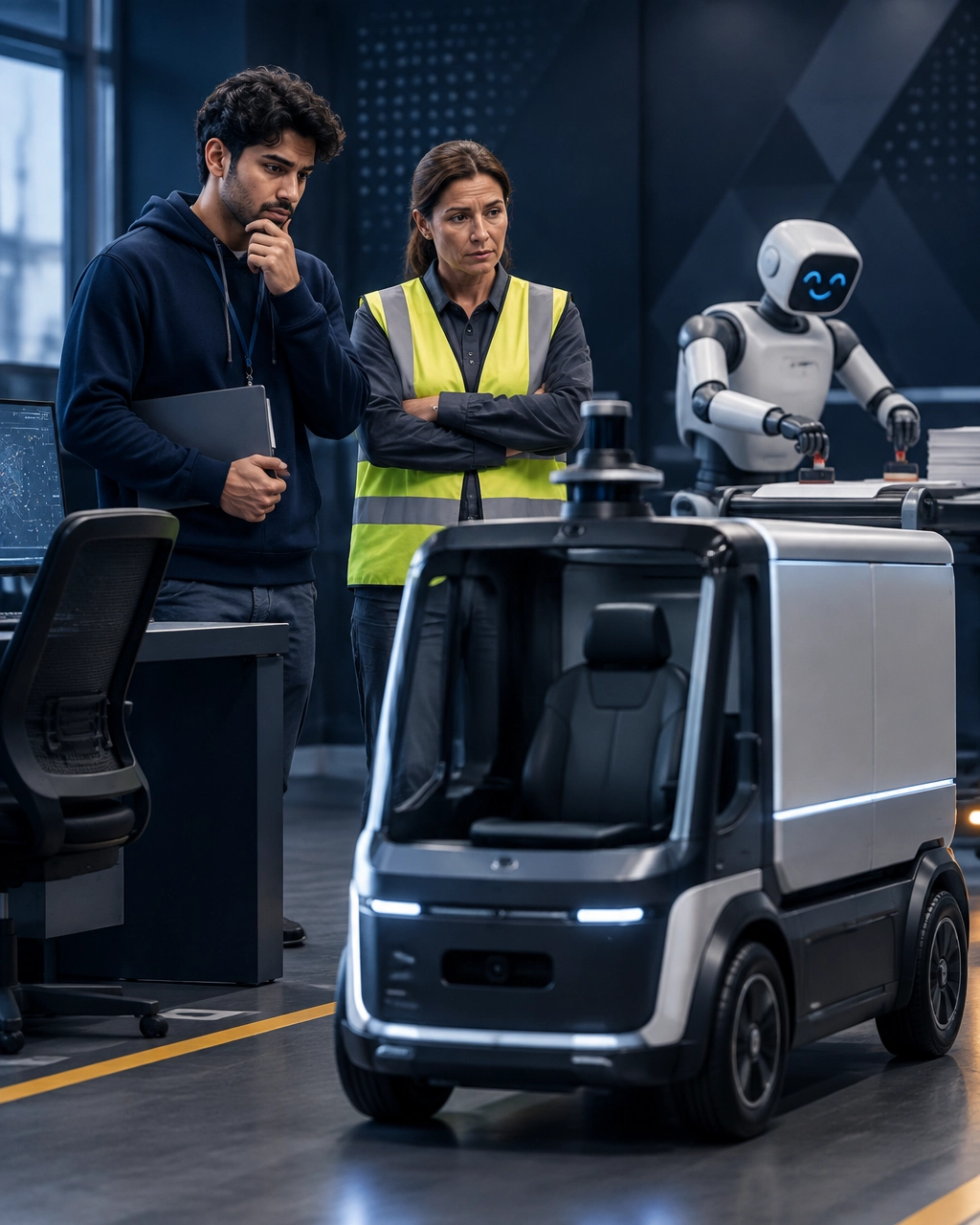
The same pressure is reaching manufacturing. U.S. manufacturing employment was above 12.8 million workers in 2024 and remained in the low-12-million range in 2025, depending on the measurement series used. At the same time, automation and productivity improvements continue to support high output with fewer production workers.
In other words, a factory can produce more while hiring fewer people. That is excellent for output. It is less reassuring if your career depends on being one of those people.
Trucking is changing in a similar way. Route optimization, predictive maintenance, fleet analytics, automated dispatch, and autonomous-vehicle pilots are reshaping how freight moves. Human drivers remain essential, particularly for first-mile, last-mile, urban, and complex delivery work. But the long-haul segments most vulnerable to standardization are already attracting serious automation investment.
Challenger, Gray & Christmas reported that U.S. employers attributed approximately 112,713 announced job cuts to AI through July 2026. That number represents employer explanations for announced cuts: not an independent audit proving that AI directly replaced every position. But the message is still clear: companies are using AI as a reason to redesign workforces now.
The old question was, “Will AI affect my job someday?”
The better question is, “What will I own when my employer no longer needs the job in its current form?”
The Pivot: From Employee Dependence To Business Ownership
A franchise is not an escape from risk. It is a different way to manage risk.
As an employee, you typically own your skills, experience, and professional network. Those assets can help you find another job, but they do not give you control over the company’s customers, systems, revenue, or growth decisions.
With franchise ownership, you build an operating business supported by a proven brand, established processes, training, marketing, and ongoing guidance. You are still responsible for execution. You still need adequate capital. You still need to review the franchise disclosure document, validate the economics, and consult qualified legal and financial professionals.
But you are building an asset instead of waiting for an annual performance review to determine your future.
That distinction matters for workers in industries facing automation.
IT And Coding Professionals
Technology workers often bring strong analytical skills, project-management experience, process discipline, and comfort with systems. Those capabilities transfer well into service franchises, business-to-business operations, education businesses, technology-enabled services, and consulting-related models.
You may not need to write software for your next business. You may need to manage people, interpret performance data, improve workflows, and solve customer problems: skills AI does not automatically provide.
Manufacturing Professionals
Manufacturing leaders understand quality control, scheduling, safety, throughput, procurement, and continuous improvement. These skills are valuable in home improvement, commercial services, logistics support, maintenance, and operationally structured franchise businesses.
The ability to follow a process: and improve it without breaking it: is one of the most transferable capabilities in business ownership.
Trucking And Logistics Professionals
Drivers, dispatchers, fleet managers, and logistics coordinators understand timing, customer service, equipment, compliance, routing, and the cost of inefficiency.
That knowledge can support opportunities in automotive services, moving and storage, commercial maintenance, delivery support, home services, and other businesses where reliability and operational discipline matter.
You do not need to find a franchise that duplicates your current job. In fact, FranLift notes that many franchise owners enter industries where they have no prior experience. The objective is to match your capabilities, capital, lifestyle preferences, and goals with the right operating model.
Why Franchising Can Be A Stronger Career Pivot
The franchise model offers several advantages over starting an independent business from a blank page.
A Proven Operating Framework
A franchise typically provides documented procedures, training, brand standards, marketing resources, and operational support. You are not required to invent every system while simultaneously trying to serve customers.
That structure can be particularly valuable for professionals moving from a specialized career into business ownership.
Transferable Skills
The best franchises to own are not determined by popularity alone. They are determined by fit.
A former programmer may thrive in a process-driven service company. A manufacturing supervisor may excel in a business requiring scheduling and quality management. A truck driver may understand customer urgency, routing, and field operations better than a first-time owner with a purely financial background.
Multiple Business Formats
Franchise opportunities range from home-based and mobile models to retail locations, commercial services, education, wellness, food, automotive, hospitality, and home improvement.
Some require a large facility and significant staffing. Others are designed around lower overhead, recurring service, or flexible territory development. The right choice depends on your available capital, desired schedule, management preferences, and long-term objectives.
A Large And Growing Sector
The International Franchise Association and FRANdata projected that franchising would generate more than $936.4 billion in U.S. economic output in 2025 and add approximately 210,000 jobs.
That does not make every franchise a good investment. It does demonstrate that franchising is a substantial business sector with established demand, significant employment, and thousands of available concepts.
The opportunity is not to buy any franchise. It is to identify the franchise for sale that fits your financial capacity and operating strengths.

How To Buy A Franchise Without Making A Panic Decision
Urgency should prompt action: not reckless spending.
Start with a structured evaluation:
- Define your ownership goals. Decide whether you want a hands-on business, a manager-led operation, a home-based model, or a business you can scale over time.
- Establish your financial range. Review liquidity, credit, retirement assets, debt obligations, working capital needs, and your personal income requirements.
- Identify transferable strengths. Document the systems, leadership, sales, technical, operational, or customer-service skills you already possess.
- Compare industries and business models. Evaluate demand, staffing requirements, territory availability, recurring revenue, operational complexity, and franchisor support.
- Review the Franchise Disclosure Document. Examine fees, litigation, bankruptcy history, financial performance representations, franchisee contacts, territory terms, and renewal conditions.
- Speak with current franchisees. Ask what surprised them, what they would do differently, how long ramp-up took, and whether the franchisor delivered the support described.
- Use qualified advisors. A franchise attorney and financial professional can help you evaluate contractual and financial issues before you sign.
A franchise consultant can help organize this process by narrowing thousands of brands into a practical shortlist. The consultant’s role is not to guarantee success or choose for you. It is to help you ask better questions and avoid wasting time on businesses that conflict with your goals.
The Next Move Is Yours
AI may change your job. It may change your industry. It may change the definition of “secure employment.”
It does not have to determine your entire financial future.
Buying a franchise is not a guaranteed escape from economic disruption. It is a deliberate way to explore ownership, leverage proven systems, and create a business that may be more aligned with your skills and lifestyle than your current role.

FranLift provides a free consultation and franchise matchmaking service for candidates. The process begins with your goals, budget, preferred involvement, and experience. FranLift then researches relevant industries and introduces you to a curated group of brands. Candidates do not pay for the service because participating franchise companies cover the cost through their development budgets.

If your career is becoming more automated, start researching before your employer makes the decision for you. Contact FranLift to discuss franchise opportunities, financing considerations, and the next step toward ownership.
You can also learn more about how FranLift matches candidates with franchise businesses, including opportunities in service, education, wellness, home improvement, automotive, retail, food, hospitality, and other industries.
Your paycheck may have a termination date. Your ability to build something you own does not have to.
Sources And Data Notes
- Goldman Sachs: How Will AI Affect the U.S. Labor Market?
- Goldman Sachs: The Jobs AI Is Likely To Boost: And Those It May Disrupt
- U.S. Bureau of Labor Statistics: Computer Programmers
- U.S. Bureau of Labor Statistics: Job Opportunities In Manufacturing
- International Franchise Association: Franchising Economic Outlook
- International Franchise Association: 2025 Economic Outlook
- McKinsey: Will Autonomy Usher In The Future Of Truck Freight Transportation?
FranLift does not provide legal, tax, investment, or financial advice. Franchise ownership involves risk, and performance varies by brand, market, capital structure, and owner execution. Launch Beyond Boundaries.
